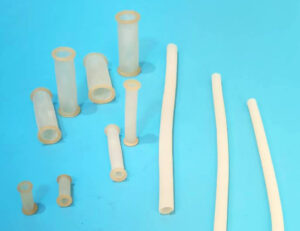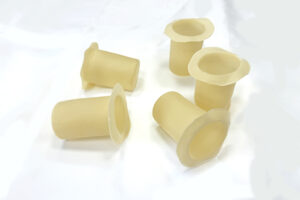
Latex membrane thickness affects triaxial test results by changing the mechanical restraint applied to a deforming specimen and the membrane’s resistance to puncture, tearing and penetration into surface voids.
A thicker membrane is generally more durable, but it can develop greater tensile force as the specimen expands laterally. This additional restraint may influence the measured deviator stress, deformation and apparent strength.
A thinner membrane usually introduces less mechanical restraint, but it may be more vulnerable to:
- puncture by angular particles;
- damage during installation;
- localized thinning;
- leakage during testing;
- variation caused by poor handling.
The correct membrane thickness is therefore not simply the thinnest or thickest available option. It must balance test accuracy, specimen protection, sealing reliability and the applicable correction procedure.
Important: This guide explains general membrane effects. The required membrane dimensions and corrections should follow the current applicable test standard, equipment instructions and approved laboratory procedure.
Short Answer
Membrane thickness matters because a triaxial latex membrane is part of the specimen boundary.
As the specimen expands laterally, the membrane stretches and develops circumferential tension. A thicker or stiffer membrane generally develops more force at the same deformation.
This can make the specimen appear:
- slightly stronger;
- less laterally deformable;
- less dilative;
- stiffer at some strain levels.
The effect is more likely to be significant for:
- small-diameter specimens;
- soft soils;
- low effective confining stresses;
- large axial strains;
- thick or stiff membranes;
- tests requiring sensitive deformation measurements.
Thickness also affects puncture resistance and membrane penetration, so reducing thickness is not always the correct solution.
What Does the Latex Membrane Do?
In a conventional triaxial test, a cylindrical specimen is enclosed in a flexible membrane and placed inside a pressure cell.
The membrane:
- separates the specimen and pore fluid from the cell fluid;
- allows cell pressure to act around the specimen;
- maintains the controlled drainage boundary;
- follows the specimen as it consolidates and deforms.
The cell-pressure system generates the confining pressure. The membrane does not generate it.
However, the membrane is not mechanically neutral. When it stretches, it develops force and resists specimen deformation.
For a complete explanation of the membrane’s function, see Triaxial Latex Membranes: Function, Selection, Installation and Test Effects.
Why Does Thickness Create Additional Restraint?
During axial compression, the specimen normally shortens and expands laterally. Lateral expansion stretches the membrane around the circumference.
The stretched membrane develops tensile stress. That tensile stress creates an inward mechanical action on the specimen boundary.
For a simplified thin cylindrical membrane, the equivalent inward pressure associated with circumferential membrane tension can be expressed conceptually as:
$$
p_m \approx \frac{2T_m}{D}
$$
where:
- (p_m) is the equivalent radial restraint;
- (T_m) is the circumferential membrane force per unit axial length;
- (D) is the current specimen diameter.
The membrane force is related to membrane stress and current wall thickness:
$$
T_m = \sigma_m t_m
$$
where:
- (\sigma_m) is tensile stress in the membrane at the relevant extension;
- (t_m) is current membrane thickness.
Combining these relationships gives:
$$
p_m \approx \frac{2\sigma_m t_m}{D}
$$
This simplified relationship explains several important trends:
- increasing membrane thickness can increase restraint;
- increasing membrane tensile stress can increase restraint;
- decreasing specimen diameter can make the effect more important;
- restraint changes as the specimen and membrane deform.
This is not a universal correction equation for every triaxial test. Actual deformation may be nonuniform, membrane behavior may be nonlinear and the membrane may experience both circumferential and axial strain.
Use the correction required by the applicable test method rather than applying this simplified relationship directly to reported results.
Thickness and Stiffness Are Different Properties
Thickness and stiffness are related to membrane force, but they are not interchangeable.
Two membranes with the same thickness can behave differently because of differences in:
- rubber formulation;
- degree of vulcanization;
- tensile modulus;
- aging condition;
- temperature;
- strain rate;
- previous stretching;
- manufacturing process.
Similarly, two membranes made from the same compound can produce different forces if their thicknesses differ.
A useful assessment therefore considers:
- nominal thickness;
- actual thickness distribution;
- tensile stress at relevant working extension;
- specimen diameter;
- expected lateral deformation;
- test temperature;
- test duration.
Shore hardness alone is not enough to predict membrane force. Hardness is an indentation measurement and does not directly define tensile response at the membrane’s working strain.
Why the Thickness-to-Diameter Relationship Matters
The same membrane can have a different relative effect on specimens of different diameters.
A useful qualitative indicator is the ratio:
$$
\frac{t_m}{D}
$$
where:
- (t_m) is membrane thickness;
- (D) is specimen diameter.
As this ratio increases, the membrane’s influence may become more important, assuming the membrane material and strain condition remain comparable.
For example, a particular thickness may have a relatively small effect on a large, strong specimen but a more noticeable effect on a small specimen of soft clay.
Thickness should therefore never be selected without considering specimen diameter.
How Thickness Can Affect Deviator Stress
In conventional triaxial compression, deviator stress is commonly calculated from axial load and corrected specimen area.
The measured axial response can include a contribution associated with membrane deformation.
If that contribution is significant and not corrected, the reported soil resistance may be overestimated.
The possible bias depends on:
- membrane thickness;
- membrane stress–strain behavior;
- specimen diameter;
- axial strain;
- lateral expansion;
- deformation localization;
- effective confinement;
- soil strength.
The effect may be proportionally greater when the soil’s true strength is low.
This is why membrane correction deserves particular attention in low-stress tests on soft or weak specimens.
How Thickness Can Affect Stress–Strain Behavior
A thick or stiff membrane may resist lateral expansion and alter the apparent stress–strain curve.
Possible observations include:
- increased measured resistance;
- reduced radial strain;
- reduced apparent dilation;
- delayed or changed bulging;
- altered post-peak response;
- different strain localization.
These changes should not automatically be attributed to membrane thickness. Similar patterns may result from:
- end restraint;
- specimen density differences;
- saturation differences;
- strain-rate effects;
- specimen disturbance;
- incorrect area correction;
- equipment compliance;
- measurement error.
A controlled comparison should keep the specimen preparation, dimensions, stress path and equipment conditions as consistent as practical.
Does Thickness Directly Affect Pore Pressure?
Membrane thickness does not directly determine the pore-water pressure generated by the soil.
Pore-pressure response is primarily related to:
- soil structure;
- saturation;
- stress history;
- consolidation condition;
- loading path;
- drainage condition;
- strain rate.
However, membrane condition can indirectly affect pore-pressure measurements if it causes:
- leakage;
- specimen disturbance;
- nonuniform deformation;
- boundary restraint;
- incorrect saturation or consolidation;
- failure of the intended undrained boundary.
It is therefore inaccurate to state that a thinner membrane automatically produces more accurate pore pressure or a higher saturation parameter.
A low B-value should not be diagnosed as a membrane-thickness problem without checking saturation, drainage-system compliance, trapped air, transducer performance, valves and leakage.
Does Thickness Affect Drainage Rate?
Membrane wall thickness does not normally control the intended drainage path in a conventional triaxial test.
Drainage is generally controlled through:
- porous stones;
- filter paper;
- side drains when used;
- tubing;
- valves;
- pressure or volume controllers.
Membrane thickness may affect installation around drainage components, but it should not be described as directly controlling how quickly water escapes through the specimen ends.
If consolidation or drained shearing is unexpectedly slow, investigate:
- soil permeability;
- specimen drainage length;
- porous-stone condition;
- filter condition;
- side-drain arrangement;
- tubing and valve restrictions;
- applied stress increment;
- drainage-system saturation;
- temperature.
Membrane Thickness and Volume-Change Measurement
Thickness can influence volume-change interpretation through more than one mechanism.
Mechanical restraint
A thicker or stiffer membrane may restrict radial deformation, influencing actual specimen volume change.
Membrane penetration
Cell pressure can push the membrane into voids between particles at the surface of a granular specimen.
The measured change can then include membrane movement rather than only deformation of the soil skeleton.
Wrinkles
An oversized or poorly installed membrane may form folds. As those folds flatten or move, they can contribute to unstable or misleading volume-change readings.
Leakage
A punctured membrane or defective end seal can allow fluid to move through an unintended path. That movement can be mistaken for specimen drainage.
These mechanisms should be diagnosed separately because they require different corrective actions.
Membrane Penetration and Thickness
Membrane penetration occurs when the membrane enters surface voids between particles under cell pressure.
Its significance depends on:
- particle size;
- particle angularity;
- surface-void geometry;
- cell pressure;
- membrane material;
- membrane thickness;
- tensile stiffness;
- specimen diameter;
- test duration.
A thicker or stiffer membrane may resist some local penetration, but it may also create greater general restraint.
This creates a tradeoff:
- a very flexible membrane may reduce overall restraint but enter surface voids more readily;
- a thicker or stiffer membrane may reduce penetration in some conditions while increasing mechanical boundary force.
There is no universal thickness that eliminates both effects.
For a detailed discussion, see Membrane Penetration Effect in Triaxial Testing Explained.
Thin Versus Thick Membranes
| Consideration | Relatively thin membrane | Relatively thick membrane |
|---|---|---|
| Mechanical restraint | Generally lower for the same compound | Generally higher |
| Puncture tolerance | Generally lower | Generally higher |
| Installation damage | More sensitive | May be easier to handle |
| Local wall thinning | More consequential | May retain more material |
| Membrane penetration | May be greater in surface voids | May be reduced in some conditions |
| Wrinkle formation | Depends mainly on fit and installation | Depends mainly on fit and installation |
| Influence on soft specimens | Often lower | May be more significant |
| Suitability for angular particles | Requires careful risk assessment | May offer more protection |
| Need for correction | Can still be required | More likely to be significant |
These are general tendencies, not product guarantees.
The actual result depends on compound, dimensions, strain, pressure and specimen characteristics.
How Thickness Matters in UU, CU and CD Tests
The mechanical principles do not change according to the test abbreviation, but the consequences of failure or bias differ.
UU Test
A UU test is performed without consolidation under cell pressure and without drainage during shearing.
Important membrane considerations include:
- maintaining an undrained boundary;
- avoiding specimen disturbance;
- preventing puncture during rapid preparation;
- limiting excessive restraint on weak specimens.
A thicker membrane should not automatically be selected merely because the test is short.
CU Test
A CU test allows consolidation before undrained shearing. Pore pressure may be measured during shearing.
Important considerations include:
- reliable sealing during saturation and consolidation;
- preventing slow leakage;
- maintaining pore-pressure integrity;
- limiting membrane restraint;
- documenting any correction.
Membrane thickness does not directly improve pore-pressure measurement. Seal integrity and system performance are the relevant factors.
CD Test
A CD test allows drainage during consolidation and slow shearing.
Important considerations include:
- stable sealing over a potentially long duration;
- reliable volume-change measurement;
- membrane penetration in granular soil;
- creep or property change during long exposure;
- mechanical restraint during dilation.
A thin membrane is not automatically best for CD testing. Puncture risk, test duration and particle characteristics still matter.
Why Fixed Thickness Tables Can Be Misleading
A table that assigns one membrane thickness to every clay, sand or gravel is usually too simplistic.
Thickness selection also depends on:
- actual specimen diameter;
- maximum particle size;
- particle angularity;
- expected surface voids;
- soil strength;
- confining pressure;
- expected strain;
- test duration;
- membrane compound;
- installation method;
- available correction;
- required measurement accuracy.
Statements such as “add 0.05 mm above 400 kPa” should not be used unless supported by a validated laboratory procedure or product-specific test program.
Similarly, particle size alone does not determine thickness. A fine but highly angular material may present a different risk from a rounded material with the same median particle size.
For practical selection criteria, see How to Choose the Right Thickness and Size of Latex Membrane for Triaxial Tests.
Thickness Uniformity
Average thickness can hide local variation.
A membrane with one thin area may:
- stretch disproportionately;
- puncture prematurely;
- develop a local bulge;
- tear during installation.
A locally thick area may:
- create nonuniform restraint;
- deform differently;
- affect repeatability.
Thickness quality control should therefore address both nominal thickness and variation along the membrane.
Possible measurement positions include:
- several circumferential locations;
- several axial locations;
- both end zones;
- the central specimen zone.
The measurement procedure must avoid damaging or significantly compressing the rubber.
A controlled-force thickness gauge or another validated method is preferable to an uncontrolled measurement that gives different readings depending on operator pressure.
For production quality control, measurements may be performed on representative samples from the lot rather than on every membrane intended for testing.
Thickness Changes During Installation
The membrane’s wall thickness may decrease when it is stretched over the specimen.
Therefore:
- relaxed thickness is not always the same as installed thickness;
- an undersized membrane can become thinner after excessive expansion;
- local stretch variation can create local thickness variation;
- nominal supplier thickness alone may not describe the installed boundary.
The membrane’s initial internal diameter and specimen fit should be controlled along with thickness.
Do not choose an undersized membrane and assume that stretching it thinner will reduce boundary effects. Excessive stretch can increase tensile force and damage risk even as the wall becomes thinner.
Temperature, Time and Aging
Latex is viscoelastic, so its response may vary with temperature, loading rate and duration.
Membrane behavior can change because of:
- stress relaxation;
- creep;
- repeated stretching;
- heat;
- oxidation;
- ozone;
- ultraviolet exposure;
- chemical contact;
- long-term immersion.
A membrane suitable for a short test at room temperature may behave differently during a long-duration test at another temperature.
For comparative testing:
- maintain consistent laboratory temperature;
- store membranes consistently;
- record batch or lot information;
- avoid mixing aged and new membranes within one test series;
- inspect elastic recovery before use;
- document long-duration exposure.
How to Select an Appropriate Thickness
Use the following process rather than a universal thickness table.
Step 1: Define the specimen
Record:
- diameter;
- height;
- soil type;
- maximum particle size;
- particle angularity;
- surface condition;
- expected strength;
- expected lateral deformation.
Step 2: Define the test
Record:
- UU, CU or CD condition;
- total and effective stress range;
- maximum cell pressure;
- back pressure;
- expected axial strain;
- test temperature;
- expected duration;
- required measurements.
Step 3: Define the membrane properties
Obtain, where available:
- material;
- nominal thickness;
- thickness tolerance;
- internal diameter;
- diameter tolerance;
- tensile behavior at relevant extension;
- elongation;
- tear resistance;
- storage guidance;
- chemical compatibility.
Step 4: Evaluate the main risk
Determine whether the dominant concern is:
- excessive restraint;
- puncture;
- installation damage;
- membrane penetration;
- long-duration sealing;
- chemical exposure;
- dimensional inconsistency.
Step 5: Check the correction procedure
Confirm whether the applicable standard or laboratory method requires a membrane correction and what measurements are necessary.
Step 6: Validate unusual applications
For unusual specimen sizes, coarse material, high pressure or long-duration tests, conduct a documented evaluation before adopting a new membrane specification.
How to Compare Two Membrane Thicknesses
If a laboratory needs to evaluate membrane influence, use a controlled comparison.
Keep the following as consistent as practical:
- soil source;
- specimen preparation;
- density or void ratio;
- water content;
- saturation;
- specimen dimensions;
- stress path;
- confining pressure;
- strain rate;
- drainage condition;
- equipment;
- calculation method.
Record:
- membrane material;
- batch;
- initial dimensions;
- nominal and measured thickness;
- internal diameter;
- installation observations;
- damage or wrinkles;
- correction method.
Compare:
- corrected and uncorrected deviator stress;
- stress–strain response;
- pore-pressure response;
- volumetric response;
- radial deformation;
- failure mode;
- repeatability.
One specimen per thickness may not be sufficient to separate membrane influence from natural specimen variability.
Membrane Correction Principles
Membrane correction should follow the applicable test method or a validated laboratory procedure.
A correction may require information about:
- membrane thickness;
- specimen diameter;
- membrane tensile properties;
- axial strain;
- current specimen geometry;
- membrane force;
- test conditions.
Do not:
- use one correction percentage for every strain;
- apply a correction developed for another membrane without verification;
- assume the effect is negligible because the membrane is thin;
- assume all measured strength differences come from the membrane;
- subtract an estimated value without documenting the method.
Reports should state whether results are:
uncorrected for membrane effectsor:
corrected using the specified methodThe correction reference and input values should be recorded.
Troubleshooting Thickness-Related Symptoms
| Observation | Possible membrane-related explanation | Other causes to check |
|---|---|---|
| Higher measured resistance | Excessive membrane restraint | Density, saturation, rate, area correction |
| Reduced lateral strain | Membrane restraint | Radial sensor error, end restraint |
| Reduced apparent dilation | Membrane restraint | Specimen density, stress path, drainage |
| Unexpected volume reduction in sand | Membrane penetration | Leakage, controller error, air |
| Membrane tears during mounting | Too thin, undersized or aged | Sharp stretcher, tools, poor technique |
| Membrane punctures under pressure | Insufficient local protection | Angular particles, apparatus burr |
| Repeated variation between tests | Thickness or material inconsistency | Specimen variability, calibration |
| Low B-value | Possible leakage | Incomplete saturation, trapped air, compliance |
| Noisy volume-change curve | Wrinkles or leakage | Temperature drift, controller instability |
Do not diagnose membrane thickness from one symptom alone.
Reporting Checklist
Consider recording:
Specimen ID:
Test type:
Specimen diameter:
Specimen height:
Soil description:
Maximum particle size:
Membrane material:
Membrane manufacturer:
Batch or lot:
Nominal membrane thickness:
Thickness tolerance:
Measured thickness method:
Membrane internal diameter:
Membrane length:
Installation observations:
Visible wrinkles:
Damage observed:
Maximum cell pressure:
Test temperature:
Maximum axial strain:
Membrane correction used:
Correction reference:
Corrected or uncorrected result:
Consistent reporting helps identify whether changes in membrane supply or thickness correspond with changes in test response.
Frequently Asked Questions
Does a thicker membrane make soil appear stronger?
It can increase mechanical restraint and contribute to measured resistance, particularly for small, soft or low-stress specimens. The significance must be evaluated for the actual setup.
Is the thinnest membrane always the most accurate?
No. A very thin membrane may puncture, leak or penetrate surface voids. Test reliability requires a balance between low restraint and adequate integrity.
Does membrane thickness change pore pressure?
It does not directly determine soil pore pressure. Leakage, restraint or specimen disturbance may indirectly affect the measured response.
Does a thick membrane slow drainage?
Not normally through the intended drainage path. Drainage is controlled mainly by the specimen, porous stones, filters, tubing, valves and pressure system.
Does thickness affect the B-value?
Not directly. A low B-value may result from leakage, but it can also reflect incomplete saturation, trapped air, system compliance or measurement problems.
Should thicker membranes be used at high cell pressure?
Higher pressure can increase the consequences of puncture and penetration, but pressure alone does not determine thickness. Specimen surface, diameter, membrane material and correction requirements must also be considered.
What thickness should be used for clay?
There is no universal clay thickness. Consider specimen diameter, strength, surface condition, pressure, expected strain, membrane properties and the applicable standard.
What thickness should be used for sand or gravel?
Particle size, angularity and surface voids increase puncture and penetration concerns. Selection may require a thicker membrane or another permitted protection strategy, balanced against increased restraint.
Does membrane thickness remain constant during testing?
No. Stretching can reduce wall thickness, and deformation may not be uniform along the specimen.
Is thickness tolerance important?
Yes. Local thin areas can become failure points, while local thick areas can create nonuniform restraint.
Can two tests using different thicknesses be compared directly?
Use caution. Apply the required corrections and consider whether membrane properties, specimen preparation and other test conditions are comparable.
Conclusion
Latex membrane thickness influences triaxial testing through two competing requirements.
The membrane must be flexible enough to minimize unwanted mechanical restraint, but durable enough to survive installation, confinement and specimen deformation without puncturing or leaking.
A relatively thick membrane can increase radial restraint and affect measured stress or deformation. A relatively thin membrane can reduce restraint but may be more vulnerable to damage and penetration into granular surface voids.
Thickness should therefore be selected together with:
- membrane material and tensile behavior;
- specimen diameter;
- soil strength;
- particle size and angularity;
- test pressure;
- expected strain;
- test duration;
- installation method;
- required correction;
- measurement accuracy.
The goal is not to select the thinnest membrane. It is to establish a controlled, repeatable specimen boundary whose mechanical influence is understood, minimized where practical and corrected when required.