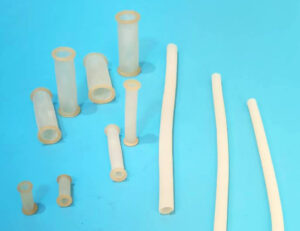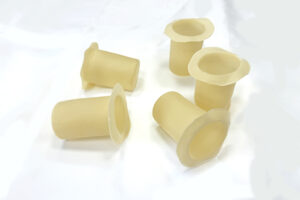
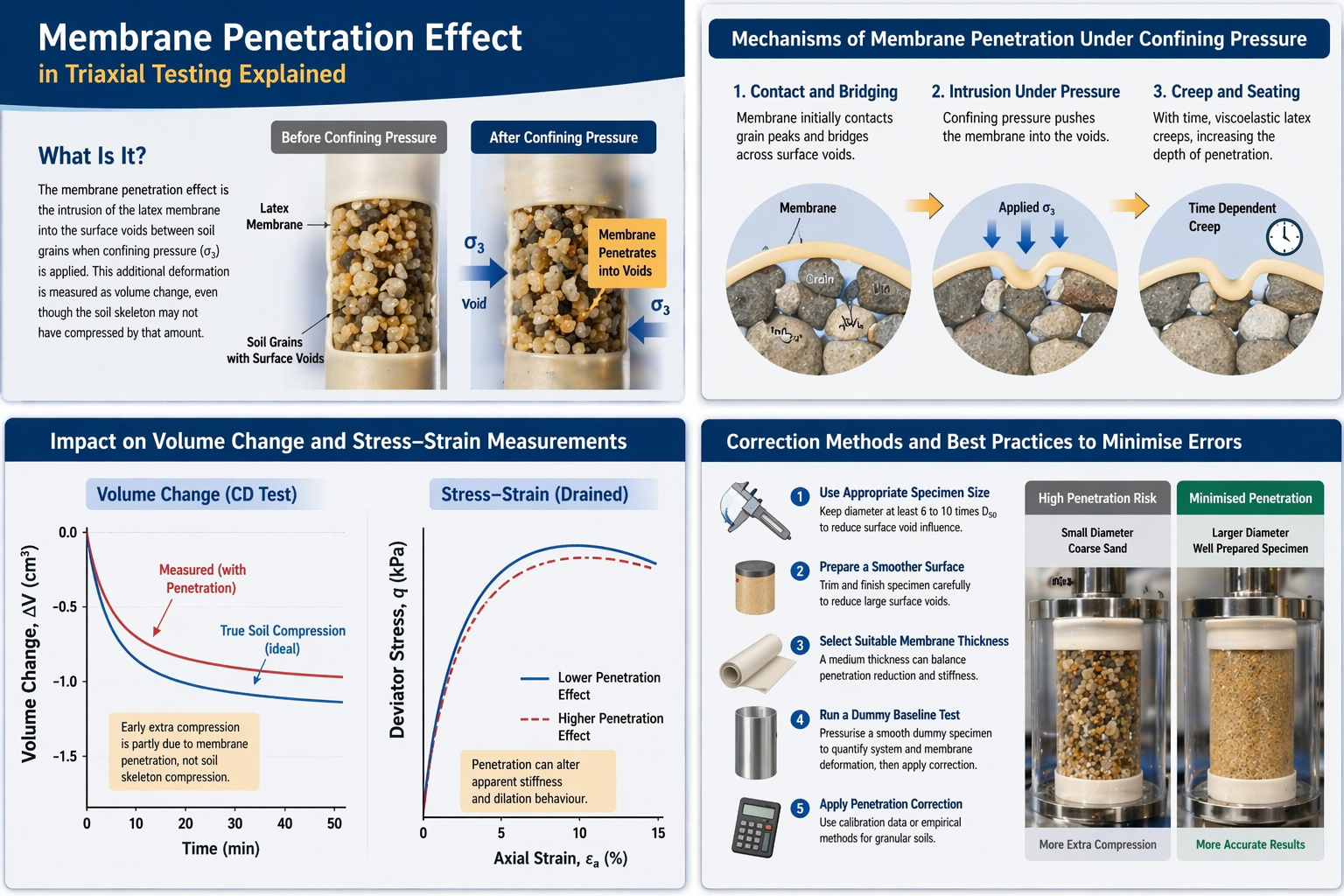
Membrane penetration is a boundary effect that occurs when the flexible rubber membrane surrounding a triaxial specimen is pressed into surface voids between soil particles.
It is most important in granular and coarse-grained specimens with rough surfaces or relatively large boundary voids.
As effective confining pressure changes, the membrane can move farther into or out of these voids. The resulting membrane displacement may be recorded as part of the specimen’s apparent volume change, even though it is not entirely caused by deformation of the soil skeleton.
In undrained testing, membrane compliance can also create an unintended volume-change mechanism. This can alter pore-pressure development and make the test less representative of an ideal constant-volume condition.
Membrane penetration should therefore be considered when interpreting:
- Isotropic consolidation
- Drained volume change
- Dilatancy
- Pore-pressure response
- Static undrained tests
- Cyclic triaxial tests
- Liquefaction resistance
- Critical-state behavior
- Coarse-grained soil testing
This guide explains the mechanism, distinguishes penetration from membrane restraint and outlines practical approaches to measurement, mitigation, correction and reporting.
Important: No single correction is appropriate for every soil, membrane and apparatus. Laboratories should use the procedure required by the applicable test standard or a validated method supported by relevant research.
What Is Membrane Penetration?
A triaxial specimen is enclosed in a flexible membrane and subjected to cell pressure.
If the specimen surface were perfectly smooth, the membrane would contact it along a relatively regular cylindrical boundary.
A granular specimen is different. Its surface contains:
- Particle contacts
- Projecting grains
- Valleys between grains
- Open surface voids
- Local changes in curvature
When effective confining pressure acts against the membrane, the membrane can deflect into these surface voids.
This local movement is called membrane penetration.
Figure 1. Replace this placeholder with an original cross-sectional diagram showing a membrane bridging surface particles and deflecting into the voids.
Why Does Membrane Penetration Create a Measurement Error?
A volume-change system normally records the total response of everything connected to the measurement.
A simplified representation is:
[
\Delta V_{\text{measured}}
\Delta V{\text{soil}}
+
\Delta V{\text{membrane}}
+
\Delta V_{\text{system}}
]
where:
- (\Delta V_{\text{measured}}) is the volume change indicated by the apparatus;
- (\Delta V_{\text{soil}}) is the actual soil-skeleton volume change;
- (\Delta V_{\text{membrane}}) is the apparent volume change associated with membrane penetration or recovery;
- (\Delta V_{\text{system}}) includes other apparatus effects such as tubing, fluid and controller compliance.
The exact sign convention depends on the laboratory’s reporting system.
The central issue is that the apparatus does not automatically know which part of the measured volume came from the soil and which part came from movement of the membrane at the specimen boundary.
If membrane penetration is ignored, the true soil volume change may be overestimated.
Membrane Penetration vs Membrane Restraint
These two effects are related to the membrane but are not the same.
| Effect | Mechanism | Primary concern |
|---|---|---|
| Membrane penetration | Membrane moves into or out of surface voids | Volume change, pore pressure and boundary compliance |
| Membrane restraint | Membrane resists lateral specimen deformation | Measured stress and stress–strain response |
| End restraint | Friction and geometry near specimen ends restrict deformation | Nonuniform strain and failure mode |
| Membrane leakage | Fluid crosses a hole or failed seal | Loss of boundary control and invalid measurements |
Membrane Penetration
Penetration is controlled mainly by the interaction between:
- Effective confining pressure
- Particle size
- Surface void geometry
- Gradation
- Specimen density
- Specimen diameter
- Membrane properties
Membrane Restraint
Restraint is related to the membrane’s tensile resistance as the specimen expands laterally.
It is influenced by:
- Wall thickness
- Rubber stiffness
- Specimen diameter
- Axial strain
- Radial deformation
- Soil strength
A thicker or stiffer membrane may reduce local penetration while increasing restraint. Membrane selection therefore requires a balance rather than simply choosing the thickest available product.
Which Soils Are Most Affected?
Membrane penetration is usually more important in specimens with pronounced surface voids.
Potentially sensitive materials include:
- Sands
- Gravelly sands
- Sandy gravels
- Crushed aggregates
- Rockfill
- Coarse residual soils
- Broadly graded granular materials
- Specimens with angular particles
- Specimens with irregular surfaces
Fine-grained cohesive specimens generally have smaller surface voids, so penetration may be less significant. However, membrane restraint, leakage and installation damage can still affect those tests.
Membrane penetration should not be evaluated from a soil name alone. Relevant properties include:
- Maximum particle size
- Characteristic particle sizes
- Gradation
- Particle angularity
- Surface roughness
- Relative density
- Specimen preparation
- Diameter-to-particle-size relationship
- Effective confining stress
Factors That Affect Membrane Penetration
Effective Confining Pressure
Increasing effective confining pressure can push the membrane farther into surface voids.
If effective stress later decreases, the membrane may recover partially out of those voids. In an undrained cyclic test, this recovery can create additional space and alter pore-pressure development.
The relevant variable is often effective confining pressure rather than total cell pressure by itself.
Particle Size
Larger surface particles can create larger voids into which the membrane may deflect.
Research has repeatedly identified particle size as an important factor, but no single particle-size parameter is universally sufficient for every gradation.
Depending on the correction method, relevant parameters may include:
- Maximum particle size
- (D_{50})
- (D_{20})
- Other characteristic sizes
- Full gradation curve
Use the parameter required by the selected method rather than substituting one particle-size measure for another.
Gradation
Two specimens with a similar median particle size may have different surface void structures if their gradations differ.
Broadly graded and gap-graded materials can produce different boundary geometry from uniformly graded materials.
Particle Shape and Surface Roughness
Angular or crushed particles may produce:
- Sharper local contacts
- Larger irregular voids
- Greater puncture risk
- More complex membrane deformation
Rounded particles may create a different contact condition even when their nominal size is similar.
Specimen Density
Relative density or compaction condition can change the void structure at the specimen boundary.
A denser specimen may have a different surface arrangement and membrane response from a loose specimen of the same material.
The effect is not necessarily captured by particle size alone.
Specimen Diameter
For otherwise similar conditions, a larger specimen can reduce the proportion of apparent volume change associated with its boundary.
Published research has found that the relative membrane-penetration contribution can decrease as specimen diameter increases.
However, specimen size must comply with the applicable standard and maximum-particle-size requirements. Selecting a larger specimen is not a substitute for following those requirements.
Membrane Thickness and Stiffness
A thicker or stiffer membrane may bridge surface voids more effectively and reduce local intrusion.
However, it may also:
- Increase membrane restraint
- Affect stress calculations
- Be more difficult to install
- Create a more significant tensile correction
Thickness should therefore not be increased without evaluating the tradeoff.
Time
Rubber is viscoelastic, so its deformation may change with time.
During long pressure holds, the membrane may continue to seat against the specimen surface. Apparatus drift, temperature and fluid compliance can produce similar trends, so time-dependent movement should not automatically be attributed only to membrane penetration.
Installation Quality
Wrinkles and uneven tension can create artificial boundary irregularities.
Installation problems include:
- Oversized membrane
- Twisting
- Folds
- Uneven stretching
- Membrane trapped beneath an O-ring
- Local damage
- Incomplete contact
A penetration correction cannot compensate for poor membrane installation.
Effects During Isotropic Consolidation
During isotropic consolidation, an increase in effective confining pressure can cause:
- Compression of the soil skeleton
- Membrane penetration into surface voids
- Compression or movement within the drainage system
- Controller and tubing compliance
- Temperature-related volume changes
The measured drainage volume can therefore include more than soil-skeleton compression.
If penetration is significant and not corrected, the specimen may appear more compressible than it actually is.
This can affect:
- Consolidation curves
- Initial specimen-volume estimates
- Void-ratio calculations
- Subsequent stress calculations
- Critical-state interpretation
Effects in Consolidated Drained Tests
During properly controlled drained shearing at approximately constant effective confining pressure, the change in penetration may be smaller than during a pressure-increase stage.
However, penetration can still matter because:
- The initial consolidation volume may already contain a penetration component.
- The specimen surface and boundary geometry change during shear.
- Local dilation or contraction can change membrane contact.
- Effective stress may not remain perfectly constant in every stress-path test.
- Large deformation can alter the specimen radius and boundary.
If the initial corrected specimen volume is wrong, later volumetric-strain calculations may also be wrong.
Potential interpretation errors include:
- Excessive apparent contraction
- Muted apparent dilation
- Incorrect void ratio
- Shifted critical-state location
- Incorrect state-parameter calculations
Effects in Static Undrained Tests
In an ideal undrained test, the soil specimen does not exchange water and its total volume is treated according to the applicable saturated-soil assumptions.
Membrane penetration introduces compliance at the specimen boundary.
As effective stress changes during undrained loading, the membrane may move into or recover from surface voids. This can permit a small change in the space available to the specimen even though the drainage valves are closed.
Possible consequences include:
- Modified pore-pressure response
- Delayed pore-pressure buildup
- Altered effective stress path
- Apparent deviation from ideal constant-volume behavior
- Incorrect interpretation of undrained response
The significance depends strongly on the material, apparatus and stress path.
Effects in Cyclic and Liquefaction Tests
Membrane penetration can be particularly important in undrained cyclic tests on gravelly or coarse granular specimens.
During cyclic loading:
- Pore pressure changes.
- Effective confining stress changes.
- The membrane may move into or recover from surface voids.
- Boundary compliance creates additional volume capacity.
- Pore-pressure development can be delayed or reduced.
This can cause the test to behave as if it were partially drained, even when the drainage lines are closed.
Potential consequences include:
- Slower excess pore-pressure buildup
- More loading cycles before reaching a defined criterion
- Overestimated liquefaction resistance
- Altered cyclic stress–strain behavior
- Incorrect comparison between specimen sizes or gradations
Recent research on crushed gravel has shown that membrane penetration can make it difficult to maintain a strict undrained condition and that existing corrections may not cover every coarse material.
How Can You Recognize Possible Membrane Penetration?
Membrane penetration cannot be confirmed from one curve alone, but possible indicators include:
- Large apparent volume change during confining-pressure increase
- Volume response that depends strongly on particle size
- Results that vary with specimen diameter
- Delayed pore-pressure buildup in coarse undrained specimens
- Different results when membrane thickness changes
- Long drift during a constant-pressure hold
- A large difference between coarse specimens and smoother reference materials
- Unusual sensitivity to effective stress
These observations may also result from:
- Leakage
- Trapped air
- Incomplete saturation
- Temperature changes
- Controller drift
- Drainage-system compliance
- Incorrect zeroing
- Specimen preparation differences
The full system should be checked before assigning the response to membrane penetration.
What Can a Rigid Dummy Specimen Measure?
A rigid dummy specimen can be useful for evaluating parts of the apparatus response.
Depending on the setup, it may help quantify:
- Tubing compliance
- Fluid compressibility
- Controller response
- Cell-system deformation
- Leakage
- Temperature drift
- Some membrane-related baseline behavior
However, a smooth rigid cylinder does not reproduce the void structure of a granular specimen.
It therefore cannot, by itself, measure the complete penetration response caused by actual particle size, gradation, density and surface roughness.
A dummy test is a system check—not a universal membrane-penetration correction.
Methods Used to Evaluate Membrane Penetration
Published approaches include:
- Empirical relationships based on particle size
- Calibration against specimens of different diameters
- Tests using reference surfaces
- Graphical correction methods
- Constitutive-model-based corrections
- Specialized devices for direct or indirect displacement measurement
- Compliance-ratio methods for undrained cyclic systems
- External displacement-measurement systems
- Physical surface-mitigation methods
Each approach has limitations.
Before selecting a method, confirm:
- Soil type covered by the method
- Particle-size range
- Gradation range
- Membrane properties
- Specimen-size range
- Stress range
- Static or cyclic loading
- Drained or undrained condition
- Required input measurements
- Sign convention
- Validation data
Do not combine variables from different published methods unless the combined procedure has been validated.
General Correction Framework
For drained volume-change interpretation, a general conceptual correction is:
[
\Delta V_{\text{soil}}
\Delta V_{\text{measured}}
\Delta V_{\text{system}}
\Delta V_{\text{membrane}}
]
This equation only expresses the bookkeeping principle. It does not provide a method for calculating (\Delta V_{\text{membrane}}).
The membrane term must come from:
- The applicable standard
- A published correction method
- A laboratory calibration
- A validated apparatus-specific procedure
For undrained testing, the issue may need to be expressed as system or membrane compliance rather than simply subtracting a final volume.
The laboratory should use the framework appropriate to the test type.
Practical Ways to Reduce the Effect
Use a Suitable Specimen Size
The specimen diameter must satisfy the applicable particle-size and test-standard requirements.
For coarse materials, a larger specimen may reduce the relative influence of the boundary. Do not use an unsupported universal ratio based only on (D_{50}).
Improve Surface Consistency
Prepare the specimen surface according to the applicable method.
The goal is not to artificially fill surface voids unless a validated procedure specifically allows it. Uncontrolled smoothing or adding fines can change the specimen itself.
Select Membrane Thickness Carefully
A thicker membrane may reduce local penetration but increase restraint.
Selection should consider:
- Particle size
- Surface roughness
- Specimen diameter
- Soil strength
- Stress range
- Test type
- Correction requirements
Avoid Wrinkles
A correctly sized membrane installed with a suitable stretcher can reduce artificial folds and boundary irregularity.
Maintain Consistent Installation
For comparative testing, keep the following consistent:
- Membrane material
- Batch, when practical
- Thickness
- Diameter
- Stretcher
- O-rings
- Installation procedure
- Operator training
Control Temperature
Temperature changes can affect water volume, pressure readings and rubber response.
Monitor and control the laboratory environment when measuring small volume changes.
Check for Leakage
Slow leakage can resemble penetration-related drift.
Test:
- Tubing
- Fittings
- Valves
- Cell seals
- Loading-ram seals
- Membrane
- O-ring seals
Use an Appropriate Correction
Apply a correction only when:
- The method is applicable to the tested material.
- Required input data are available.
- Units and sign conventions are clear.
- The method is documented.
- Uncertainty is acceptable for the intended interpretation.
Surface-Coating and Other Mitigation Methods
Research has examined physical methods that reduce penetration by modifying the specimen boundary.
For example, recent work on crushed gravel evaluated a prefabricated fines-soil sheet used to smooth the specimen surface. The method reduced the measured compliance associated with membrane penetration in the tested materials.
Such methods should not be improvised during routine testing.
Adding a coating, fines layer or another interface can change:
- Boundary friction
- Local drainage
- Particle movement
- Specimen composition
- Membrane contact
- Test comparability
Use a physical mitigation method only when it is defined, validated and permitted by the research or test procedure being followed.
What Should Be Reported?
If membrane penetration is potentially important, report:
- Test type
- Applicable standard
- Soil gradation
- Maximum particle size
- Relevant characteristic particle sizes
- Particle shape description
- Specimen diameter and height
- Specimen density or preparation condition
- Membrane material
- Membrane thickness
- Membrane diameter
- Membrane batch, if available
- Effective confining stress
- Measurement system
- System-compliance calibration
- Selected penetration method
- Correction equation or reference
- Assumptions
- Units
- Corrected and uncorrected results
- Limitations and uncertainty
Reporting both corrected and uncorrected curves can help reviewers understand the importance of the adjustment.
Common Mistakes
Treating All Measured Drainage as Soil Compression
Part of the response may come from membrane penetration and apparatus compliance.
Treating Penetration and Restraint as the Same Effect
They have different mechanisms and may require different corrections.
Using Only a Smooth Dummy Cylinder
This can characterize system response but does not reproduce granular surface voids.
Using a Universal Particle-Size Formula
A method calibrated for one soil or gradation may not apply to another.
Using a Universal Specimen-to-(D_{50}) Ratio
Standards may use maximum particle size or other criteria. Follow the applicable method.
Selecting a Thick Membrane Without Checking Restraint
Reduced penetration can be offset by increased tensile restraint.
Attributing All Drift to Latex Creep
Leakage, temperature and equipment compliance must also be checked.
Applying a Static Correction to Cyclic Testing
Cyclic undrained membrane compliance may require a different evaluation.
Hiding the Correction
A correction that materially changes the result should be reported transparently.
Frequently Asked Questions
Is membrane penetration a soil property?
No. It is an interaction between the specimen surface, membrane, stress condition and apparatus.
Particle size and density influence it, but it is not an intrinsic soil property independent of the test setup.
Is membrane penetration important for clay?
It is generally more significant for granular materials with larger surface voids.
For cohesive specimens, membrane restraint, leakage and installation disturbance may be more important, although the actual test conditions should still be reviewed.
Does a thicker membrane eliminate penetration?
No.
It may reduce local deflection into surface voids, but it can increase membrane restraint. The tradeoff must be evaluated.
Does penetration occur only during consolidation?
No.
It can occur whenever the effective stress acting at the membrane boundary changes. Its consequences differ between drained, static undrained and cyclic tests.
Is penetration important at constant cell pressure?
It can still matter because effective stress may change even when total cell pressure remains constant. Specimen deformation and boundary geometry may also change.
Can a dummy specimen provide the correction?
A smooth rigid dummy can help characterize system compliance and drift, but it does not reproduce the actual voids between soil particles.
Additional calibration or a validated correction method is usually required.
Does membrane penetration make drained tests appear more contractive?
It can cause measured volume change to include a membrane component, leading to overestimation of soil-skeleton volume change if left uncorrected.
The direction and magnitude must be evaluated using the test’s sign convention and stress path.
Can it affect liquefaction resistance?
Yes.
In undrained cyclic testing of coarse granular soils, membrane compliance can delay pore-pressure buildup and lead to overestimation of cyclic or liquefaction resistance.
Should corrected and uncorrected data both be saved?
Yes. Retaining raw data, calibration data and corrected results improves traceability and allows the correction to be reviewed later.
Conclusion
Membrane penetration occurs when the flexible triaxial membrane moves into surface voids between soil particles.
Its significance depends on:
- Particle size
- Gradation
- Particle shape
- Surface roughness
- Specimen density
- Specimen diameter
- Effective confining stress
- Membrane thickness and stiffness
- Test duration
- Static or cyclic loading
- Drained or undrained conditions
- Apparatus compliance
The effect is primarily associated with volume measurement and boundary compliance, but it can also alter pore-pressure development and effective stress paths.
A reliable evaluation requires more than observing early contraction or running a smooth dummy specimen. Laboratories should distinguish penetration from restraint and leakage, select an applicable correction method, preserve raw data and document all assumptions.
Discuss Your Triaxial Membrane Requirements
When requesting a membrane for granular or coarse-soil testing, provide:
- Specimen diameter
- Specimen height
- Soil gradation
- Maximum particle size
- Surface condition
- Membrane inside diameter
- Required length
- Preferred thickness
- Effective confining-stress range
- Test type
- Static or cyclic loading
- Expected strain
- Test duration
- Required quantity
We can review available membrane dimensions and custom manufacturing requirements. Selection of the correction method remains the responsibility of the testing laboratory and geotechnical professional.
[Button: Discuss Your Triaxial Membrane Requirements]
Technical References
-
Ramana, K.V. and Raju, V.S. “Membrane Penetration in Triaxial Tests.” Journal of the Geotechnical Engineering Division, 108(2), 1982. DOI: 10.1061/AJGEB6.0001247.
-
Frydman, S., Zeitlen, J.G. and Alpan, I. “Membrane Effect in Triaxial Testing of Granular Soils.” Journal of Testing and Evaluation, 1(1), 1973.
-
Liu et al. “A Novel Procedure to Measure Membrane Penetration of Coarse Granular Materials.” Applied Sciences, 12(13), 6381, 2022. DOI: 10.3390/app12136381.
-
“Sheet-coating mitigation for membrane penetration in undrained triaxial tests and evaluation of comprehensive liquefaction resistance of crushed gravel.” Soils and Foundations, 64(3), 2024. ScienceDirect article.
-
Albar, A., Osman, M.H. and Nyuin, J.D. “Influence of membrane penetration on granitic residual soil in consolidated drained triaxial test.” Physics and Chemistry of the Earth, 128, 103254, 2022. ScienceDirect article.