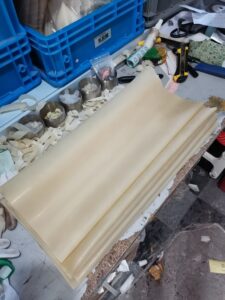
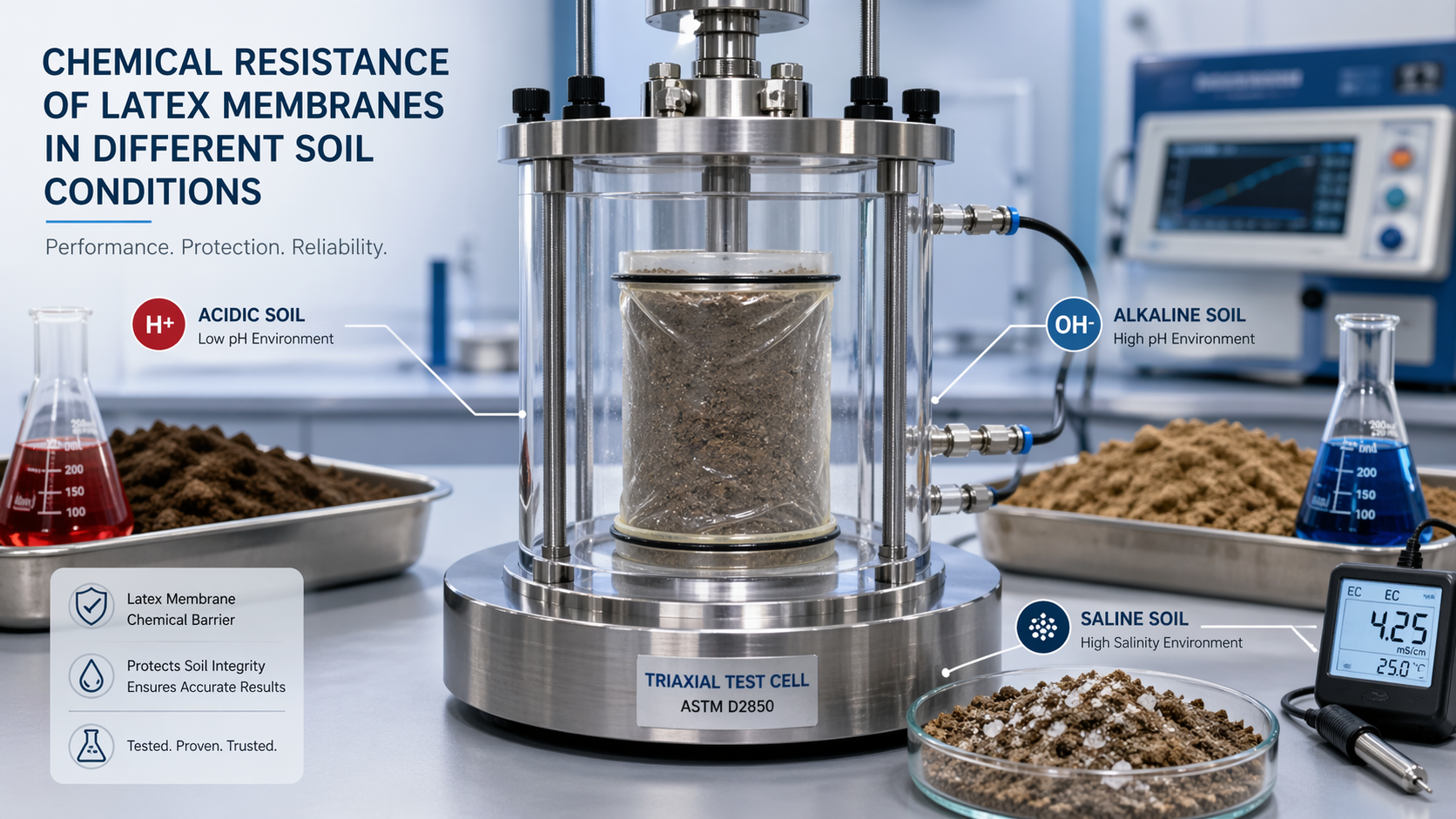
I used to assume “soil is just soil.” Then a salty sample turned a good membrane tacky overnight.
Latex membranes are strong and flexible, but their chemical resistance depends on soil chemistry, pore fluid, temperature, and test duration. Understanding interactions helps you prevent leaks, drift, and late-stage failures.
Let’s talk about what really happens in different soil conditions.
Chemical Composition of Soils and Their Interaction with Latex Membranes
Soil chemistry isn’t only minerals—it’s also pore water: ions, pH, and dissolved organics.
Latex mainly interacts with the pore fluid and dissolved chemicals; pH extremes, salts, oils, and oxidisers can change latex elasticity, surface tack, and long-term strength.
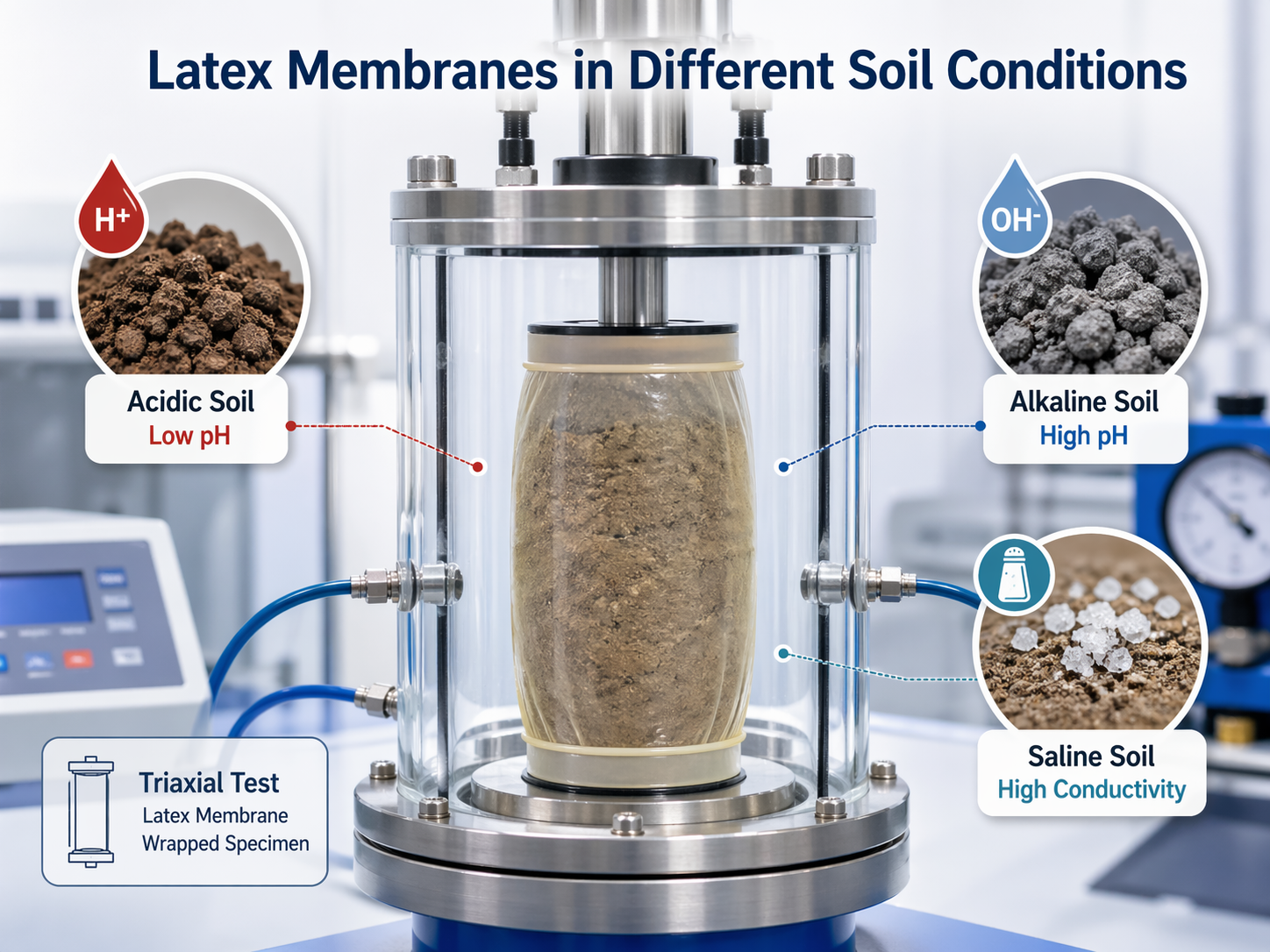
When we say “chemical resistance,” we’re mostly talking about what the membrane touches for hours: water + dissolved chemistry. Even if the soil is dry-looking, the pore fluid is doing the talking. The big variables are pH, ionic strength (salinity), dissolved organics, and any aggressive additives (like oxidisers or solvents).
Latex is a natural polymer. It’s great at stretching and sealing, but it can be sensitive to certain chemicals—especially those that change the membrane surface, extract components, or accelerate oxidation. In the lab, I pay attention to:
- pH (acidic vs alkaline),
- chlorides/sulfates (salts),
- organic content (oils, fuels, surfactants),
- temperature and time (because chemistry gets faster when warm and long).
A quick trap: people blame “mounting” when a membrane becomes sticky, cloudy, or weaker mid-test. Sometimes, yes, it’s a bad mount. But sometimes it’s chemistry altering the latex surface. Another trap is assuming “neutral water” stays neutral—some soils release ions during consolidation, and pore water chemistry shifts.
So I always ask for a basic pore water summary if available: pH, EC (electrical conductivity), chloride, sulfate, and any contamination history. If the lab can’t measure everything, pH + EC alone already helps a lot. My quick request list is here: pore water questions.
| Soil/pore fluid indicator | Why I care | What latex might do |
|---|---|---|
| Very low/high pH | Can attack polymer surface | Softening, loss of strength |
| High salinity (EC) | Changes swelling and surface | Tackiness, stiffness shift |
| Oils/organics | Can diffuse into latex | Swelling, softening |
| Oxidisers | Accelerate aging | Brittleness, cracks |
Performance of Latex Membranes in Acidic, Alkaline, and Saline Environments
Latex is usually fine in mild conditions, but extremes demand caution.
In mildly acidic/alkaline pore water, latex performs well; strong acids/alkalis can weaken latex; high salinity can change surface feel and long-duration stability, raising leak risk in long tests.
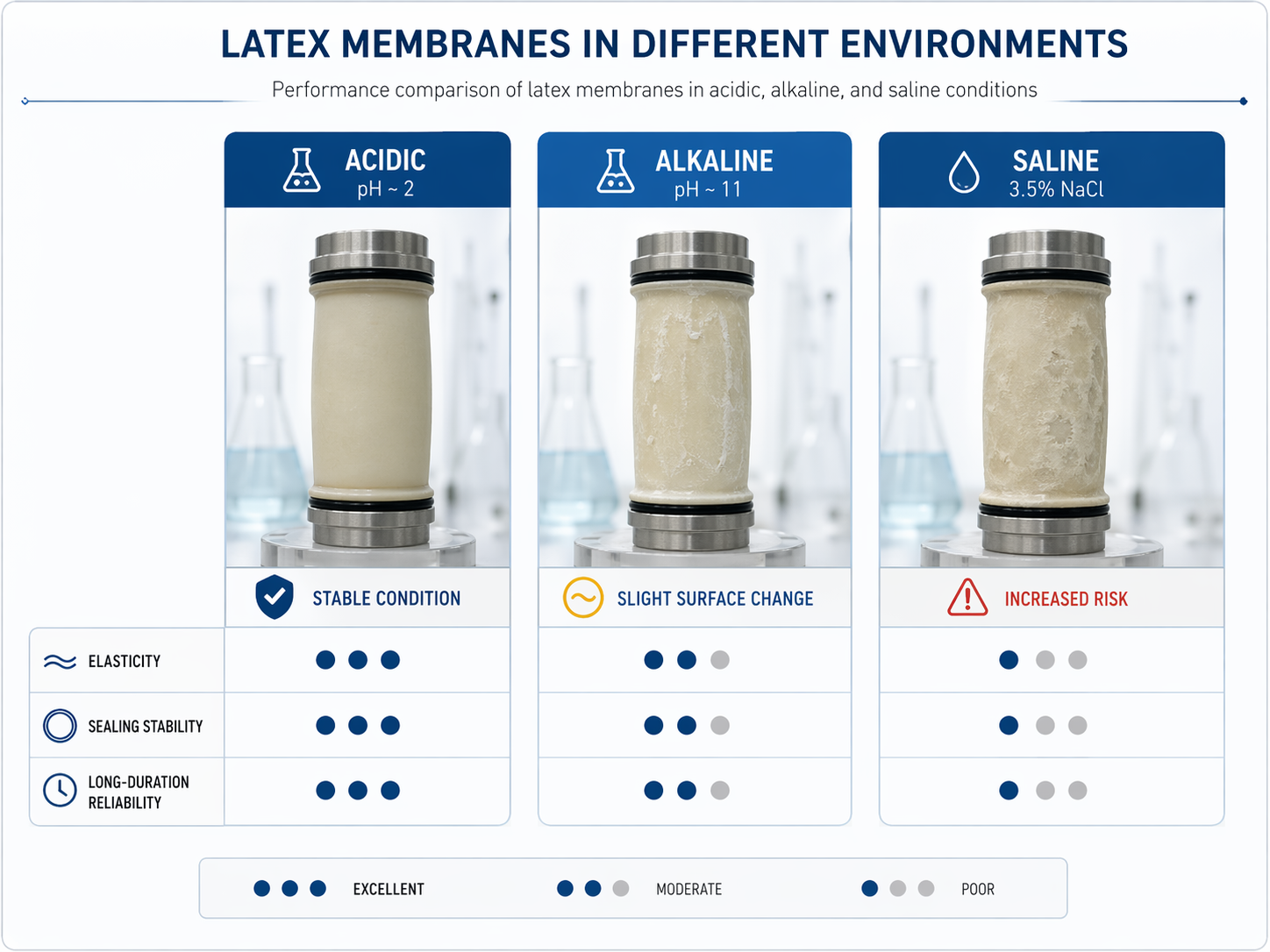
Let me keep this practical. Most geotechnical pore waters are not “chemical disasters.” In normal ranges, latex is stable enough for UU/CU/CD work. Problems appear when we push extremes or run long holds.
Acidic environments
Mild acidity is usually manageable. But stronger acids, or acids combined with elevated temperature, can accelerate surface breakdown and soften latex. In long tests, this can show up as:
- easier tearing near cap edges,
- tacky surface that grabs grains,
- slow micro-leaks that appear late.
Alkaline environments
Strong alkalinity can be rough on natural rubber. I’ve seen latex feel slightly weaker after exposure to high pH water for long durations. Not always dramatic, but enough to raise failure probability in high σ₃ programs.
Saline environments
Salts don’t always “dissolve” latex, but high ionic strength can change how the surface behaves and how quickly aging mechanisms appear. In saline sands, the membrane can look fine early, then develop small changes in elasticity and creep. The risk is not just chemical; it’s the combination: salinity + high σ₃ + long duration + temperature swings.
If I suspect harsh chemistry, I do a simple pre-check: soak a membrane coupon in the pore fluid for 24–48 hours and feel the change (tackiness, stiffness, whitening). It’s not a full standard test, but it prevents surprises: simple soak test.
| Environment | Latex performance (general) | Risk level (long test) |
|---|---|---|
| Mild acidic (near neutral) | Good | Low |
| Strong acid | Can degrade/soften | High |
| Mild alkaline | Usually OK | Medium |
| Strong alkaline | Weakening risk | High |
| High salinity | Often OK short-term | Medium–High (long duration) |
Degradation Mechanisms: Swelling, Aging, and Chemical Breakdown
Most failures are not instant. They are slow, sneaky changes in the polymer.
Latex degrades through swelling (chemical diffusion), oxidation/aging (oxygen/ozone/UV), and chemical attack (pH extremes), leading to softness, tackiness, cracks, and reduced tear strength.
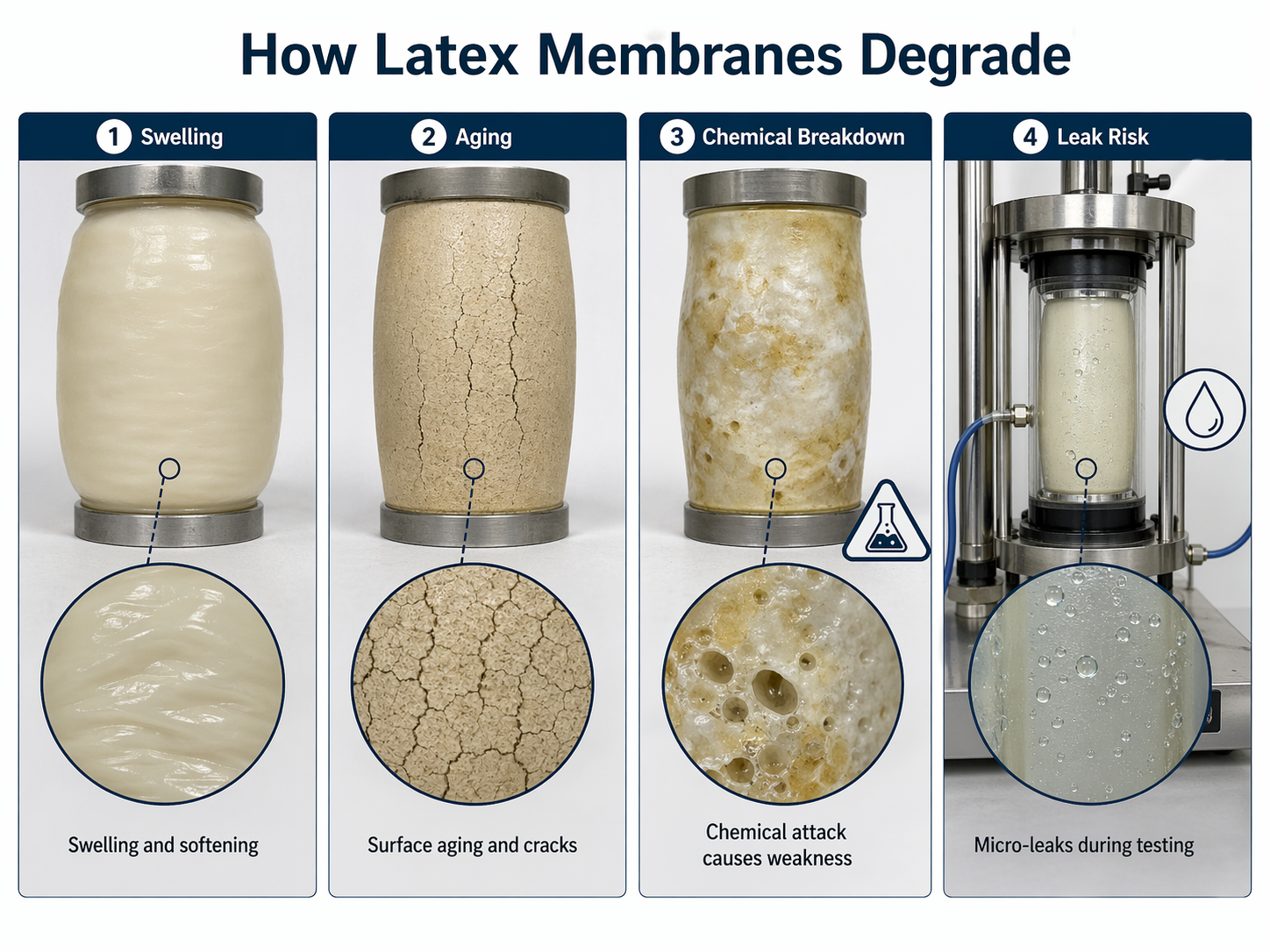
I think about degradation like three different “bad moods” latex can fall into:
1) Swelling
Some chemicals—especially oils, fuels, surfactants, and certain organics—can diffuse into latex and make it swell. Swelling usually makes latex softer and more prone to tearing. It can also change thickness and the way the membrane sits at the ends, raising leak risk.
2) Aging (oxidation and ozone)
Even without weird pore fluids, latex ages. Oxygen and ozone slowly attack the polymer, especially under tension. Add heat or UV, and the process speeds up. Aging usually makes latex brittle, and you’ll see fine surface cracks or a “dry” feel. This is why storage matters so much.
3) Chemical breakdown
Strong acids or strong alkalis can attack latex more directly. The membrane can lose strength, become sticky or weak, and fail at stress concentrations—usually near edges, rings, or wrinkles.
In long-duration tests, creep and degradation can combine. A membrane that creeps and seats deeper is under uneven tension, making it more vulnerable to chemical attack at certain spots. That’s why I always recommend two things when chemistry is harsh: (1) stable temperature, and (2) a slightly more robust membrane choice.
I also train my eye to catch early warning signs:
- surface becomes unusually tacky,
- whitening or hazing,
- sudden increase in bubble leaks during low-pressure check,
- changes in “snap-back” when stretched gently.
I keep a one-page “symptom to cause” list here: degradation fingerprints.
| Symptom | Likely mechanism | What I do |
|---|---|---|
| Sticky surface | Swelling / surface change | Consider resistant option, shorten duration |
| Brittle feel/cracks | Aging/ozone/UV | Replace lot, improve storage |
| Soft + easy tear | Chemical + swelling | Step up thickness, resistant surface |
| Late-stage micro-leaks | Creep + degradation | Pre-soak test, baseline checks |
Selecting Chemically Resistant Membranes for Reliable Triaxial Testing
Don’t guess. Match membrane choice to pore fluid risk and test duration.
For harsh chemistry or long tests, use tighter QA lots, consider chlorinated latex or alternative resistant surfaces, choose appropriate thickness, and run a short soak/baseline test before the main program.
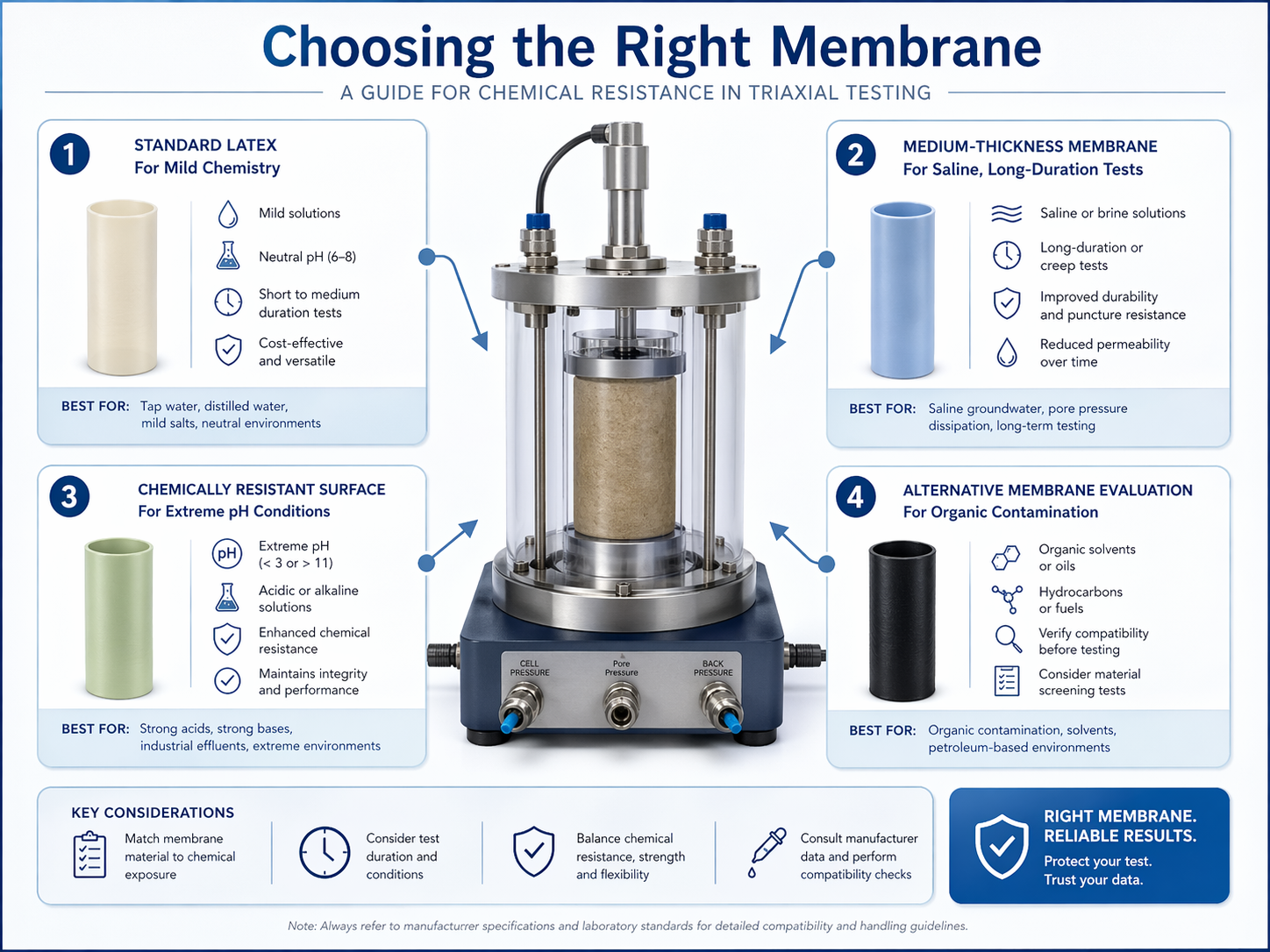
Here’s my simple selection logic when chemistry might be aggressive:
1) Classify the pore fluid risk
- If pH is near neutral and EC is modest, standard latex is usually fine.
- If pH is extreme or EC is very high, treat it as “high risk,” especially for long tests.
2) Choose a membrane that buys safety
- Medium thickness for long holds and higher σ₃.
- Smooth, clean surface to reduce chemical trapping and grain abrasion.
- Chlorinated latex when you want reduced tack and better surface resistance (it often helps with handling and some chemical exposure).
- If the environment is truly harsh (oils/solvents), consider discussing non-latex alternatives—but validate stiffness bias.
3) Do a quick verification
A 24–48 hour soak test using real pore water plus a dummy pressurisation check can prevent wasted days. If the membrane changes feel or leaks increase, adjust before you commit.
4) Control temperature and storage
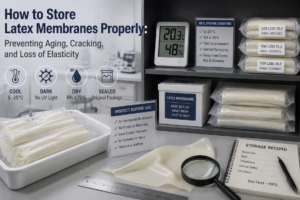
Chemical reactions speed up with heat. Keep temperature stable and store membranes sealed, cool, and dark. Rotate stock.
Here’s a practical decision table I send to labs:
| Condition | Recommended approach | Why |
|---|---|---|
| Mild chemistry, short tests | Standard latex | Best balance of sealing and fidelity |
| High salinity, long CD | Medium thickness + baseline | Reduce drift/leak risk |
| Extreme pH | Resistant surface + soak test | Prevent late-stage failure |
| Organic contamination (oils) | Evaluate non-latex + bias check | Swelling risk in latex |
If you want help selecting based on your pore fluid and σ₃ range, my team at HOWDY can advise. We’re B2B-only, and we can provide standard, transparent, and more resistant surface options—plus custom shapes if your rig is special: selection support.
Conclusion
Latex works well in most soils, but chemistry can change the rules—check pore water, test risks early, and choose membranes that stay stable for the full run.