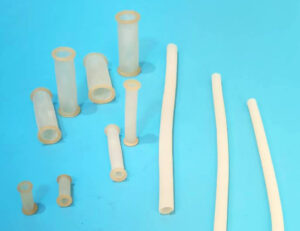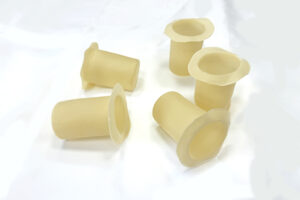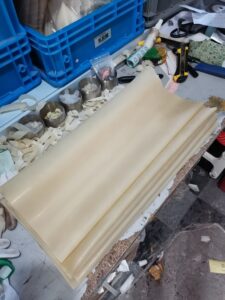
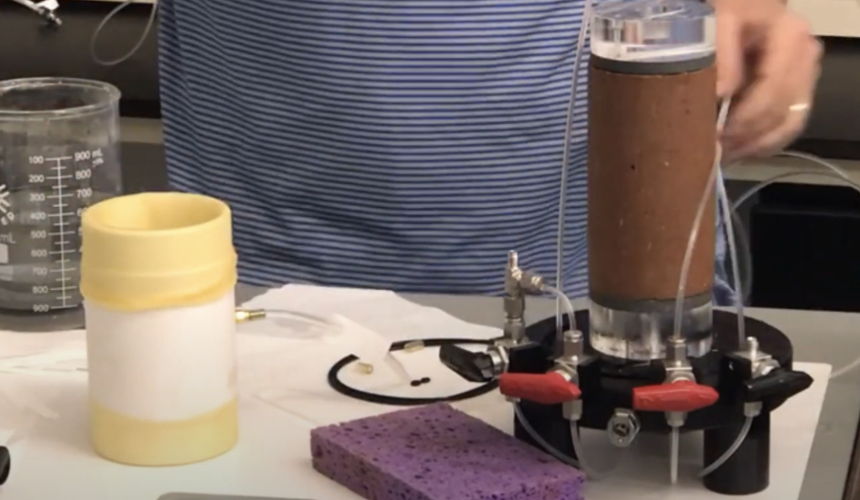
Custom latex membranes are manufactured when a standard tubular membrane cannot provide the required diameter, length, thickness or end geometry for a particular laboratory testing system.
Common applications include:
- large-diameter triaxial specimens;
- non-standard cylindrical soil or rock specimens;
- rockfill and coarse-grained material testing;
- Hoek cells and specialized rock-testing assemblies;
- flexible-wall permeability cells;
- long-duration creep experiments;
- custom research chambers;
- unusual top-cap or pedestal dimensions;
- transparent membranes for visual observation;
- special membrane lengths or thickness tolerances.
A custom membrane can improve fit and sealing, but it does not automatically make an irregular specimen suitable for a conventional triaxial test.
In most standard triaxial compression methods, the specimen is expected to be a regular right circular cylinder. If the specimen geometry falls outside the requirements of the applicable method, the test may need to be classified and reported as a non-standard research procedure.
Important: Custom membrane geometry does not replace the specimen, apparatus or reporting requirements of the applicable ASTM, ISO, BS or other test method.
Short Answer
A custom latex membrane is appropriate when a standard membrane cannot fit the specimen and sealing assembly without excessive stretch, folds, insufficient overlap or unacceptable boundary effects.
The custom design should be based on:
- actual specimen dimensions;
- top-cap and pedestal dimensions;
- sealing-groove locations;
- expected axial and radial deformation;
- membrane material;
- required wall thickness;
- pressure and temperature;
- cell and pore fluids;
- test duration;
- particle size and angularity;
- dimensional tolerances;
- quality-control and traceability requirements.
The membrane should be designed around the complete specimen assembly, not merely ordered using a nominal specimen diameter.
Does a Custom Membrane Make an Irregular Specimen Suitable for Triaxial Testing?
Not necessarily.
Conventional triaxial compression relies on assumptions about:
- specimen geometry;
- cross-sectional area;
- stress distribution;
- axial symmetry;
- deformation;
- boundary conditions.
A highly irregular or non-cylindrical specimen can make these assumptions invalid or difficult to apply.
Possible problems include:
- nonuniform stress;
- uncertain cross-sectional area;
- localized membrane tension;
- uncontrolled folds;
- premature strain localization;
- unreliable area correction;
- difficult comparison with standard test results.
A custom membrane can enclose an unusual object, but sealing the object does not prove that the measured result represents a valid conventional triaxial property.
Before testing a non-cylindrical specimen, the laboratory should define:
- the purpose of the experiment;
- the geometry and dimensional method;
- how stress and strain will be calculated;
- how boundary effects will be assessed;
- whether results will be reported as standard or non-standard;
- what limitations apply to interpretation.
Where possible, irregular soil or rock should be trimmed, cored or reconstituted into the geometry required by the selected test method.
When Is a Custom Membrane Actually Needed?
1. Non-Standard Specimen Diameter
Laboratory equipment and research programs may use specimen diameters that are not covered by common membrane sizes.
A custom internal diameter may reduce:
- excessive installation stretch;
- local wall thinning;
- folds caused by an oversized membrane;
- specimen disturbance;
- sealing difficulties.
The specified diameter should consider the actual specimen rather than only the nominal mold or coring-tool size.
2. Large-Diameter Triaxial Specimens
Large-diameter specimens may be required for materials containing coarse particles.
Possible examples include:
- gravel;
- rockfill;
- crushed aggregate;
- waste rock;
- coarse mine materials;
- large-particle engineered fill.
A larger specimen can include a more representative range of particles, but it also creates special membrane challenges:
- greater membrane circumference;
- difficult installation;
- increased puncture exposure;
- heavy top-cap and cell components;
- long required membrane length;
- large surface voids;
- membrane penetration;
- limited stretcher availability.
The specimen size must comply with the particle-size and geometry requirements of the selected testing program.
3. Unusual Specimen Height
Custom length may be needed when:
- the specimen height differs from standard laboratory dimensions;
- additional end overlap is required;
- several O-rings or sealing positions are used;
- the top cap and pedestal are unusually long;
- large axial strain is expected;
- external measurement components affect the assembly.
The required finished membrane length should include the specimen and both sealing zones.
4. Specialized Top Caps and Pedestals
Some research cells use:
- enlarged top caps;
- stepped pedestals;
- multiple drainage ports;
- local strain instruments;
- unusual O-ring positions;
- custom end restraints;
- internal sensors.
A standard membrane may fit the specimen but fail to provide suitable overlap around these components.
The supplier should receive a dimensioned drawing of the complete assembly.
5. Hoek Cells and Rock-Testing Sleeves
Rock-testing pressure cells may require membranes or sleeves with dimensions different from soil triaxial products.
Important variables include:
- core diameter;
- core length;
- end-platen geometry;
- pressure range;
- specimen roughness;
- jacket thickness;
- fluid compatibility;
- temperature;
- installation method.
A product intended for soil testing should not automatically be used in a Hoek cell without confirming the required geometry and mechanical performance.
6. Flexible-Wall Permeability Testing
Flexible-wall permeability cells also use membranes to isolate specimens from cell fluid.
Custom requirements may involve:
- specimen diameter;
- mold geometry;
- cap and pedestal dimensions;
- sealing configuration;
- long-duration exposure;
- chemical compatibility;
- back pressure;
- permeant composition.
Because the test measures fluid flow, slow membrane leakage or permeation may be especially important.
7. Long-Duration or Creep Tests
Tests lasting days, weeks or longer may require additional consideration of:
- creep;
- stress relaxation;
- aging;
- slow leakage;
- chemical exposure;
- temperature stability;
- permanent deformation;
- sealing stability.
A thicker membrane is not automatically the best solution. Long-term behavior depends on the material formulation as well as thickness.
8. Visual Observation
Transparent or translucent custom membranes may help laboratories observe:
- installation folds;
- filter-strip position;
- specimen bulging;
- visible shear zones;
- top-cap alignment;
- surface damage.
Transparency must be balanced against thickness, mechanical properties and puncture risk.
Read What Is a Transparent Latex Membrane for Triaxial Testing? for additional guidance.
Standard Size Versus Custom Size
| Condition | Standard membrane may be suitable | Custom membrane may be justified |
|---|---|---|
| Common cylindrical specimen | Yes | Usually unnecessary |
| Standard top cap and pedestal | Yes | Usually unnecessary |
| Uncommon specimen diameter | Poor fit possible | Custom internal diameter |
| Unusual specimen height | Insufficient or excessive length | Custom finished length |
| Large rockfill specimen | Standard sizes may be unavailable | Large-diameter membrane |
| Special sealing locations | Overlap may be unsuitable | Custom length or end design |
| Hoek cell | Soil membrane may not fit | Application-specific sleeve |
| Optical research | Standard membrane may obscure view | Transparent custom membrane |
| Aggressive fluid | Standard material may be incompatible | Alternative compound after verification |
| Non-cylindrical specimen | Standard method may not apply | Requires a non-standard test design, not only a custom membrane |
Custom manufacturing should solve a defined dimensional or performance problem. It should not be used as a substitute for correct specimen preparation.
Dimensions Required for a Custom Membrane
At minimum, provide the following.
Internal Diameter
Specify:
- actual specimen diameter;
- diameter variation;
- top-cap diameter;
- pedestal diameter;
- desired installed fit;
- installation method.
Do not specify the membrane according to the internal diameter of the triaxial cell.
An undersized membrane may cause:
- excessive stretching;
- local thinning;
- increased membrane tension;
- difficult installation;
- specimen disturbance;
- tearing.
An oversized membrane may cause:
- folds;
- wrinkles;
- trapped pockets;
- poor sealing;
- nonuniform contact.
Finished Length
Specify:
- specimen height;
- top-cap overlap;
- pedestal overlap;
- O-ring locations;
- number of sealing zones;
- expected axial strain;
- additional handling allowance, if required.
A membrane that is too short may pull out from beneath a seal. A membrane that is too long can create unnecessary folds near the specimen ends.
Wall Thickness
Thickness must balance:
- membrane restraint;
- puncture resistance;
- tear resistance;
- installation handling;
- particle angularity;
- pressure;
- test duration;
- specimen diameter;
- correction requirements.
A relatively thin membrane may reduce mechanical restraint but increase puncture risk. A thicker membrane may improve durability while exerting more force on the specimen.
Read How Membrane Thickness Affects Triaxial Test Results before selecting a non-standard thickness.
Dimensional Tolerances
A custom request should state tolerances separately for:
- internal diameter;
- finished length;
- wall thickness;
- thickness uniformity;
- position of any designed feature.
Do not request “high precision” without numerical criteria.
The supplier should confirm what can be manufactured and measured consistently. Extremely tight tolerances may increase cost, rejection rate and lead time without producing a meaningful test benefit.
Specimen Geometry and Surface Condition
The supplier should understand:
- whether the specimen is soil, aggregate or rock;
- maximum particle size;
- particle angularity;
- surface roughness;
- presence of fissures or protrusions;
- expected bulging;
- expected failure mode.
These details help identify puncture and deformation risks.
They do not allow the membrane manufacturer to determine whether the specimen complies with a test standard. That decision remains with the laboratory or responsible engineer.
Pressure Requirements
Provide:
- maximum cell pressure;
- back pressure;
- pressure duration;
- pressurization sequence;
- whether pressure is static or cyclic;
- relevant safety factor or laboratory specification.
A membrane’s suitability cannot be determined from pressure alone. Its installed stretch, material, thickness, surface contact and duration also matter.
Avoid claiming that a membrane is “high-pressure certified” unless there is a defined test method, acceptance criterion and supporting documentation.
Temperature and Duration
Specify:
- minimum temperature;
- maximum temperature;
- normal operating temperature;
- exposure duration;
- whether heating and cooling cycles occur.
Natural rubber properties can change with temperature and time. Long-duration tests may also involve creep, stress relaxation and aging.
Fluid and Chemical Exposure
Identify:
- cell fluid;
- pore fluid;
- permeant;
- cleaning agents;
- possible contaminants;
- fluid concentration;
- exposure temperature;
- exposure duration.
Do not use the phrase “chemical-resistant membrane” without identifying the chemical and conditions.
Natural rubber may be affected by certain oils, hydrocarbons, solvents and oxidizing chemicals. An alternative elastomer may offer better compatibility but could be stiffer or less extensible.
For a material comparison, see Latex vs. Other Elastic Membranes for Triaxial Testing.
Should a Custom Membrane Have Holes or Ports?
A conventional specimen membrane is intended to form a continuous barrier. An uncontrolled opening can allow cell fluid to contact the specimen and invalidate the drainage boundary.
If a research apparatus requires:
- sensor penetrations;
- drainage connections;
- electrical feedthroughs;
- local strain-device attachments;
- other membrane openings;
the complete penetration and sealing system must be designed and validated.
A simple hole cut into the membrane is not a suitable custom feature by itself.
The design should define:
- opening diameter;
- location;
- reinforcement;
- fitting geometry;
- sealing method;
- strain concentration;
- leakage test;
- effect on the specimen boundary.
Seamless, Molded or Joined Construction
Manufacturing methods may include dipped, molded or specially joined construction.
Each method has different constraints.
Seamless tubular construction
Potential advantages include:
- no longitudinal joint;
- more uniform circumferential deformation;
- simplified sealing;
- reduced local seam effects.
Possible limitations include tooling requirements and restrictions on complex geometry.
Molded custom geometry
Molding may support special shapes but can introduce:
- thickness transitions;
- parting lines;
- locally stiff features;
- tooling cost;
- different surface finish.
Joined or bonded construction
A joint can produce:
- local thickness increase;
- stiffness discontinuity;
- stress concentration;
- potential leakage;
- asymmetric deformation.
If a membrane contains a seam or bond, its location, construction and acceptance criteria should be disclosed and evaluated.
For sensitive triaxial measurements, a complex shape may create more uncertainty than a correctly sized simple tube.
Benefits of a Properly Designed Custom Membrane
A correctly specified custom membrane may provide:
- suitable fit without excessive stretching;
- sufficient sealing overlap;
- fewer installation folds;
- reduced specimen disturbance;
- compatibility with non-standard hardware;
- better repeatability between assemblies;
- fewer installation failures;
- improved traceability;
- more appropriate thickness for the application.
These benefits are conditional.
A custom membrane does not guarantee:
- perfectly uniform stress;
- zero boundary effect;
- compliance with every standard;
- no punctures;
- no leakage;
- more accurate results.
The membrane still requires inspection, correct installation and an appropriate test procedure.
Risks of a Poorly Specified Custom Membrane
A custom product may fail if the design is based on incomplete information.
Common specification errors include:
- supplying nominal rather than actual specimen dimensions;
- omitting top-cap and pedestal dimensions;
- forgetting O-ring locations;
- specifying only diameter;
- choosing thickness only from pressure;
- ignoring particle angularity;
- failing to disclose the cell fluid;
- assuming natural rubber resists every chemical;
- requesting an irregular shape without defining stress calculations;
- omitting dimensional tolerances;
- skipping prototype evaluation.
A custom label does not compensate for an incomplete drawing.
Prototype and Fit Verification
Before ordering a large production quantity, evaluate a prototype or small pilot batch where practical.
Dimensional Inspection
Check:
- internal diameter;
- finished length;
- wall thickness;
- thickness uniformity;
- feature locations;
- surface condition.
Use a measurement method appropriate for soft elastomeric material. Excessive measurement force can compress the membrane and produce misleading thickness values.
Dummy-Assembly Test
Use a dimensionally representative dummy specimen or assembly to check:
- stretcher compatibility;
- required installation expansion;
- end overlap;
- O-ring position;
- wrinkles;
- top-cap and pedestal fit;
- ease of removal.
A dummy fit test does not validate soil-test performance, but it can identify obvious dimensional problems without risking a real specimen.
Leakage and Pressure Evaluation
Perform any pressure or leakage evaluation using a safe, documented procedure appropriate for the equipment.
The validation should define:
- test fixture;
- fluid;
- pressure;
- pressure rate;
- hold time;
- temperature;
- acceptance criterion.
Do not assume that a short unstrained pressure check represents a long-duration membrane stretched over a rough specimen.
Mechanical Evaluation
Where membrane force matters, evaluate relevant properties such as:
- tensile stress at working extension;
- elongation;
- elastic recovery;
- tear resistance;
- permanent set;
- change after aging or fluid exposure.
Ultimate tensile strength alone does not describe the membrane’s force during normal triaxial deformation.
Repeatability
One successful installation is not enough to demonstrate production consistency.
Evaluate several samples where the application is sensitive to:
- wall-thickness variation;
- diameter variation;
- puncture;
- long-term sealing;
- optical clarity;
- membrane force.
Quality-Control Requirements
A custom membrane specification may include:
| Property | Purpose |
|---|---|
| Material or compound identification | Supports compatibility and traceability |
| Internal diameter | Controls fit and installation strain |
| Diameter tolerance | Controls repeatability |
| Finished length | Ensures specimen coverage |
| Length tolerance | Maintains sealing overlap |
| Wall thickness | Balances restraint and durability |
| Thickness tolerance | Controls weak and stiff areas |
| Visual-defect criteria | Identifies holes, inclusions and surface damage |
| Tensile test method | Provides comparable mechanical data |
| Tear test method | Supports damage-risk assessment |
| Lot identification | Connects products to inspection records |
| Packaging method | Protects against contamination and aging |
| Storage guidance | Preserves properties before use |
| Fluid-compatibility evidence | Supports non-standard exposure |
| Prototype approval | Confirms fit before production |
Only include properties that can be measured and verified.
Do not advertise a membrane as certified to a soil-testing standard unless that standard actually certifies the finished membrane and the required evidence exists.
Installation Considerations
Custom size does not eliminate the need for careful installation.
Before installation:
- measure the specimen;
- verify the custom membrane identification;
- inspect the membrane;
- inspect the stretcher;
- inspect the top cap and pedestal;
- check O-rings;
- identify sharp particles;
- confirm drainage components;
- document the assembly.
During installation:
- expand the membrane only as much as necessary;
- avoid sharp tools and fingernails;
- lower the stretcher without touching the specimen;
- release the membrane gradually;
- prevent filter displacement;
- keep the top cap aligned;
- eliminate major folds;
- maintain sufficient end overlap.
After installation:
- inspect the complete assembly;
- confirm O-ring position;
- check all drainage connections;
- complete the approved leakage checks;
- document unusual observations.
See How to Install a Latex Membrane on a Triaxial Soil Specimen for the complete procedure.
Custom Membranes and Boundary Effects
A better fit can reduce folds and unnecessary initial stretch, but every flexible membrane can still influence the specimen.
Potential effects include:
- membrane restraint;
- membrane penetration;
- end-seal stiffness;
- localized tension;
- long-duration creep;
- interaction with surface particles.
Complex custom shapes can create thickness transitions or local strain concentrations that do not occur in a simple tubular membrane.
When accurate stress and deformation measurements are required, the custom design should be evaluated as part of the complete boundary system.
Read Boundary Effects Caused by Latex Membranes in Soil Testing for more information.
Information Required for a Custom Membrane Quote
Use the following template when contacting a supplier:
Application:
Applicable test method:
Standard or non-standard test:
Specimen material:
Specimen shape:
Specimen diameter:
Diameter variation:
Specimen height:
Maximum particle size:
Particle angularity:
Surface condition:

Top-cap diameter:
Top-cap sealing length:
Pedestal diameter:
Pedestal sealing length:
O-ring groove locations:
Number and type of seals:
Membrane stretcher dimensions:

Required membrane internal diameter:
Required finished length:
Required wall thickness:
Required dimensional tolerances:
Transparent or conventional appearance:
Seamless construction required:
Special features:

Maximum cell pressure:
Back pressure:
Pressure duration:
Static or cyclic pressure:
Minimum temperature:
Maximum temperature:
Expected test duration:
Expected axial strain:

Cell fluid:
Pore fluid or permeant:
Cleaning agents:
Possible chemical contaminants:

Required quantity:
Prototype quantity:
Lot-traceability requirement:
Inspection report required:
Packaging requirement:
Target delivery date:

Drawing attached:
Photographs attached:
Additional acceptance criteria:
If you do not know the required finished membrane dimensions, provide a dimensioned drawing of the complete specimen, top cap, pedestal and O-ring arrangement.
Questions to Ask the Manufacturer
Before ordering, ask:
- Can this diameter and length be manufactured consistently?
- What dimensional tolerances are achievable?
- Is the membrane seamless?
- How is wall thickness measured?
- How is thickness uniformity inspected?
- What material formulation is proposed?
- Is the material compatible with the stated fluids?
- What tensile data are available?
- What storage conditions are recommended?
- Is lot identification available?
- Can prototypes be produced?
- What is the minimum production quantity?
- What tooling is required?
- How will design changes affect lead time?
- What are the acceptance and replacement procedures?
A responsible supplier should identify manufacturing limitations rather than promise a “perfect fit” without reviewing the complete application.
Frequently Asked Questions
What is a custom latex membrane?
It is a membrane manufactured with specified dimensions or features that differ from standard products.
Are custom membranes intended for irregular soil specimens?
Sometimes they may be used in non-standard research, but conventional triaxial specimens are generally expected to have controlled cylindrical geometry. A custom membrane does not make an irregular specimen compliant.
When should I order a custom diameter?
Consider a custom diameter when available membranes require excessive stretching or create folds around the actual specimen assembly.
Can a custom membrane reduce boundary effects?
A correct fit may reduce folds and unnecessary initial strain. The membrane can still create restraint, penetration and end effects.
Is a thicker membrane required for high pressure?
Not automatically. Pressure is only one factor. Specimen diameter, particles, surface condition, material properties, strain and correction requirements must also be considered.
Can custom membranes be transparent?
Yes, depending on material, thickness, geometry and manufacturing feasibility. Transparency should not replace mechanical or dimensional requirements.
Can drainage holes be added?
An uncontrolled hole would compromise the specimen boundary. Any opening or feedthrough requires a designed and validated sealing system.
Should a custom membrane be seamless?
Seamless construction may reduce local stiffness and leakage concerns. If a seam is necessary, its location and influence should be evaluated.
Is a prototype necessary?
A prototype is strongly advisable for unusual dimensions, expensive test programs, large quantities or sensitive measurements.
Can the membrane supplier confirm ASTM compliance?
The laboratory remains responsible for conducting the test according to the applicable standard. Avoid treating a general material supplier statement as proof that the complete test complies.
What drawing should I provide?
Provide a dimensioned drawing showing the specimen, top cap, pedestal, O-ring grooves, overlaps and any special features.
Can one custom membrane be used for several specimen sizes?
Possibly, but using one size across substantially different specimens may cause excessive stretch or folds. Each fit should be evaluated independently.
Conclusion
Custom latex membranes are useful when standard products cannot fit a non-standard triaxial or permeability assembly correctly.
The strongest applications include:
- non-standard cylindrical specimens;
- large-diameter rockfill and aggregate tests;
- unusual specimen heights;
- specialized top caps and pedestals;
- Hoek cells;
- long-duration testing;
- transparent observation;
- research apparatus with documented custom requirements.
The custom-design process should begin with the complete test configuration—not with a general request for an “irregular membrane.”
A reliable specification includes:
- actual specimen dimensions;
- complete sealing geometry;
- required thickness and tolerances;
- material and fluid compatibility;
- pressure, temperature and duration;
- surface and particle characteristics;
- prototype and acceptance requirements.
The objective is not to produce the most complex possible shape. It is to create a consistent flexible boundary that fits the assembly, maintains isolation and introduces as little uncontrolled influence as practical.