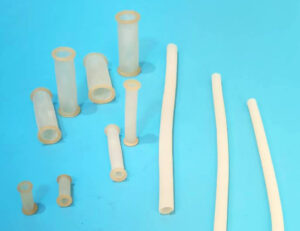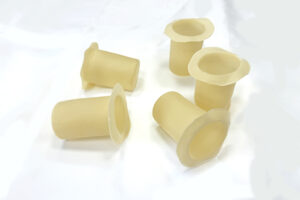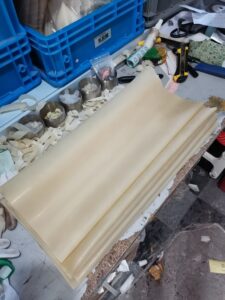
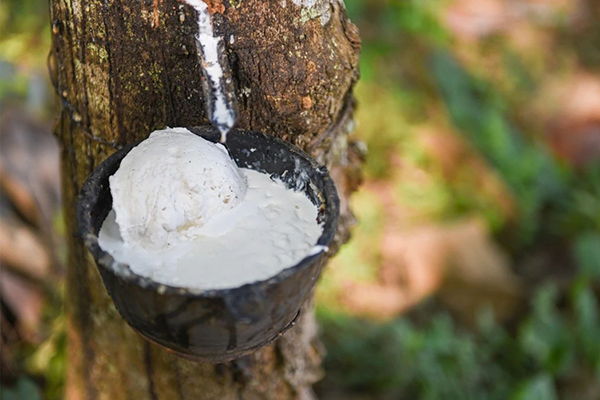
Natural latex is widely used for triaxial specimen membranes because it can combine high extensibility, elastic recovery and low resistance at relatively small wall thicknesses.
However, latex is not automatically the best membrane material for every test. Chemical exposure, temperature, ozone, sharp particles, test duration, required strain and operator safety may justify evaluating another elastomer.
The correct question is therefore not simply:
Is latex better than synthetic rubber?
A more useful question is:
Which membrane material provides the required sealing, flexibility, durability and chemical compatibility while introducing the least unacceptable influence on this particular test?
This guide compares natural rubber latex with silicone rubber, nitrile rubber, neoprene, EPDM, SBR and thermoplastic elastomers in the context of triaxial and related laboratory testing.
Short Answer
For routine soil triaxial tests using compatible cell fluids and normal laboratory temperatures, a correctly sized natural rubber latex membrane is often a practical choice because it is thin, highly extensible and easy to install.
Other materials may deserve consideration when a test involves:
- oils, fuels or unusual chemicals;
- elevated or low temperatures;
- long exposure periods;
- strong ozone or weathering exposure;
- angular particles and high puncture risk;
- natural-latex sensitivity;
- a custom geometry unavailable in conventional latex;
- application-specific regulatory requirements.
No material name alone guarantees suitable performance. The compound formulation, cure, thickness, dimensions and manufacturing quality can be as important as the base polymer.
What Does a Triaxial Membrane Need to Do?
A triaxial membrane encloses a cylindrical specimen between the base pedestal and top cap. Sealing rings secure the membrane at both ends.
Its principal functions are to:
- separate the specimen and pore fluid from the triaxial cell fluid;
- maintain a reliable seal during saturation, consolidation and shearing;
- transfer cell pressure through a flexible boundary;
- follow changes in specimen shape without tearing or leaking.
An effective membrane should provide a suitable balance of:
- low deformation resistance;
- adequate elongation;
- elastic recovery;
- puncture and tear resistance;
- dimensional consistency;
- fluid compatibility;
- aging resistance;
- reliable sealing;
- practical installation.
These requirements can conflict. Increasing thickness may improve handling and puncture resistance but also increase mechanical restraint. A chemically resistant material may be too stiff for a sensitive, low-stress soil test.
Material selection is therefore a balancing exercise rather than a search for the strongest membrane.
“Latex” and “Rubber” Are Not Opposites
Latex and rubber are sometimes treated as two different material categories, but this is misleading.
Natural rubber latex is an aqueous dispersion obtained from rubber-producing plants and processed into rubber products. The principal elastomer in natural rubber is predominantly cis-1,4-polyisoprene.
“Rubber” is a broader term that includes:
- natural rubber;
- styrene-butadiene rubber;
- nitrile rubber;
- chloroprene rubber;
- EPDM;
- silicone rubber;
- fluoroelastomers;
- other synthetic elastomers.
A finished natural latex membrane is also not pure plant sap. It is a formulated and vulcanized rubber product containing curing-system ingredients and other additives.
Comparisons should therefore use specific compound names and measured properties rather than vague labels such as “latex versus rubber.”
Natural Rubber Latex Membranes
Natural rubber latex is commonly selected for conventional soil triaxial testing.
Potential advantages
Depending on formulation and thickness, natural rubber can offer:
- high extensibility;
- good elastic recovery;
- flexibility at small wall thickness;
- close conformity to the specimen;
- straightforward installation with a membrane stretcher;
- availability in common specimen diameters;
- practical manufacturing of thin tubular shapes.
These characteristics can help the membrane follow lateral specimen deformation without excessive wrinkling.
Potential limitations
Natural rubber can be vulnerable to:
- ozone;
- ultraviolet exposure;
- oxidative aging;
- elevated-temperature aging;
- oils and some hydrocarbons;
- certain solvents and chemicals;
- puncture by angular particles;
- deterioration during unsuitable storage.
Natural rubber products may also present a concern for people with natural-rubber-latex sensitivity. Laboratories should follow their occupational health procedures and supplier safety information.
Suitable applications
Natural latex is often considered for:
- routine soil triaxial compression;
- UU, CU and CD testing under compatible conditions;
- low-to-moderate temperature laboratory work;
- specimens requiring high membrane extension;
- tests where low membrane restraint is important.
Suitability must still be verified for the actual pressure, fluid, duration and specimen surface.
Silicone Rubber Membranes
Silicone rubber is a synthetic elastomer known for retaining flexibility across a broad temperature range.
Potential advantages
Depending on the grade, silicone may offer:
- good high- and low-temperature flexibility;
- resistance to ozone and weathering;
- low-temperature performance;
- electrical insulation;
- availability in custom molded geometries.
Potential limitations
A silicone compound may have:
- lower tear resistance than some other elastomers;
- greater sensitivity to cuts or notches;
- different permeability characteristics;
- higher material or manufacturing cost;
- modulus and wall-thickness combinations unsuitable for sensitive soil tests.
Silicone should not be assumed to resist every chemical. Its compatibility varies with the fluid, temperature, exposure time and compound.
When it may be considered
Silicone may deserve evaluation for:
- temperature conditions unsuitable for natural rubber;
- long-term environmental exposure involving ozone;
- specialized research equipment;
- custom shapes requiring a silicone manufacturing process.
Before substitution, the laboratory should assess modulus, thickness, tear resistance, sealing behavior and fluid compatibility—not temperature resistance alone.
Nitrile Rubber Membranes
Nitrile rubber, often abbreviated NBR, is a synthetic copolymer commonly selected for resistance to many oils and fuels.
Potential advantages
Depending on composition, nitrile may provide:
- better resistance than natural rubber to many petroleum-based oils;
- practical mechanical strength;
- controlled formulations for industrial fluid exposure;
- resistance to some forms of abrasion.
Potential limitations
Compared with a thin natural latex membrane, a nitrile product may be:
- less extensible;
- stiffer at the required working strain;
- less suitable at low temperatures;
- unavailable in the thin tubular dimensions required;
- more difficult to stretch over a delicate specimen.
Nitrile compatibility is not universal. Its performance varies with the acrylonitrile content, compound formulation, fluid and temperature.
When it may be considered
Nitrile may be evaluated when:
- oils or hydrocarbons are present;
- natural rubber shows unacceptable swelling or property loss;
- the available nitrile membrane meets the dimensional and flexibility requirements.
A nitrile membrane should not be substituted solely because the test fluid is described as “chemical.” Compatibility must be checked for the specific fluid.
Neoprene or Chloroprene Rubber Membranes
Neoprene is a commonly used name for chloroprene rubber, also identified as CR.
Potential advantages
A suitable chloroprene compound may offer:
- better weathering and ozone resistance than natural rubber;
- useful resistance to some oils and chemicals;
- balanced mechanical durability;
- flame-resistant characteristics in certain formulations.
Potential limitations
For a triaxial membrane, chloroprene may have:
- higher stiffness than the natural latex product it replaces;
- lower extensibility in some formulations;
- limited availability in very thin seamless tubes;
- increased membrane restraint;
- chemical compatibility that still depends on the specific fluid.
When it may be considered
Chloroprene may be evaluated for specialized conditions involving weathering, ozone or particular chemical exposures, provided its modulus, dimensions and sealing performance are acceptable.
EPDM Membranes
EPDM is an ethylene-propylene-diene elastomer widely used where resistance to weathering, ozone, water and heat is important.
Potential advantages
Depending on formulation, EPDM can provide:
- strong ozone resistance;
- good weathering performance;
- resistance to water and steam under suitable conditions;
- useful heat-aging performance;
- flexibility over a practical temperature range.
Potential limitations
EPDM is generally not the first choice for contact with petroleum oils and hydrocarbon fuels. It may also be:
- stiffer than a thin natural latex membrane;
- difficult to obtain in appropriate triaxial dimensions;
- unsuitable where high installation stretch is required;
- more influential on specimen response if the wall is thick.
When it may be considered
EPDM may be considered for:
- water-based exposure;
- elevated-temperature or ozone-sensitive environments;
- specialized long-duration setups;
- applications where an appropriate thin geometry is available.
Actual fluid compatibility and membrane force must still be evaluated.
SBR Membranes
SBR stands for styrene-butadiene rubber. It is widely used in tires and general rubber products, but this does not automatically make it suitable for a triaxial membrane.
Potential advantages
A formulated SBR compound may provide:
- useful abrasion resistance;
- consistent synthetic-rubber production;
- acceptable strength for general rubber applications;
- broad commercial availability as a raw compound.
Potential limitations
For triaxial use, SBR may offer:
- less resilience or extensibility than suitable natural rubber compounds;
- limited ozone and weathering resistance without protection;
- limited oil resistance;
- higher restraint if supplied as a thicker or stiffer membrane;
- poor availability in specialized seamless dimensions.
SBR should be evaluated as a specific compound and finished membrane. Its use in tires does not prove suitability for thin specimen membranes.
Thermoplastic Elastomer Membranes
Thermoplastic elastomer, or TPE, is a broad family rather than one specific material. Thermoplastic rubber, or TPR, is also a general commercial term.
Different TPE families can have very different properties, including:
- styrenic block copolymers;
- thermoplastic polyurethanes;
- thermoplastic polyolefins;
- thermoplastic vulcanizates;
- copolyester elastomers;
- polyamide elastomers.
It is technically inaccurate to describe every TPE as more rigid, stronger or more chemically resistant than latex.
Potential advantages
Depending on the TPE family and grade, possible advantages include:
- thermoplastic processing;
- repeatable molded geometry;
- weldability in some materials;
- strong abrasion resistance in some polyurethane grades;
- tailored hardness and chemical resistance;
- custom production possibilities.
Potential limitations
Possible disadvantages include:
- higher modulus at working strain;
- lower elastic recovery in some grades;
- creep under long-term load;
- stress relaxation;
- limited extension;
- sensitivity to temperature;
- difficulty producing extremely thin seamless tubes.
When it may be considered
A TPE may be considered for a custom membrane or sleeve when its exact grade has been tested under the intended strain, pressure, temperature, fluid and duration.
The word “TPE” alone is not an adequate material specification.
Qualitative Comparison for Triaxial Applications
The following table provides general tendencies only. Actual performance can change substantially with compound formulation, cure, thickness and temperature.
| Material family | Extensibility | Ozone/weather resistance | Resistance to petroleum oils | Temperature capability | Main selection concern |
|---|---|---|---|---|---|
| Natural rubber | Often high | Generally limited without protection | Generally limited | Moderate | Aging, ozone, puncture and chemical exposure |
| Silicone rubber | Often high | Often strong | Grade-dependent and not universal | Often broad | Tear resistance, permeability and cost |
| Nitrile rubber | Moderate and grade-dependent | Moderate | Often better than natural rubber | Moderate | Stiffness, low-temperature flexibility and installation strain |
| Chloroprene rubber | Moderate | Often better than natural rubber | Moderate and grade-dependent | Moderate | Modulus, elongation and availability |
| EPDM | Moderate and grade-dependent | Often strong | Generally poor for petroleum oils | Often good | Oil incompatibility and membrane stiffness |
| SBR | Moderate | Generally limited without protection | Generally limited | Moderate | Elastic recovery, ozone resistance and geometry |
| TPE/TPR | Extremely grade-dependent | Extremely grade-dependent | Extremely grade-dependent | Extremely grade-dependent | Cannot be selected without identifying the exact polymer grade |
This table should be used only for initial screening. Final selection requires product-specific data or compatibility testing.
Why Chemical Compatibility Must Be Tested
A membrane can change when exposed to a liquid even if it does not dissolve.
Possible effects include:
- swelling;
- shrinkage;
- mass change;
- softening;
- hardening;
- loss of tensile strength;
- reduced elongation;
- discoloration;
- extraction of compound ingredients;
- increased permeability;
- cracking after exposure.
Compatibility depends on four connected variables:
- the exact elastomer compound;
- the exact test fluid;
- exposure temperature;
- exposure duration.
A general statement such as “nitrile is chemical-resistant” is insufficient because no elastomer resists every chemical.
When compatibility is uncertain, the membrane should be evaluated using the actual fluid or a justified representative fluid. ASTM D471 provides comparative procedures for evaluating the effect of liquids on rubber properties.
An immersion test alone may not reproduce a stretched membrane under differential pressure, so the final evaluation should consider the actual service condition.
Membrane Stiffness and Test Accuracy
A membrane does more than prevent leakage. It can also resist specimen deformation.
As a cylindrical specimen expands laterally, the membrane develops circumferential tension. This can add confinement or contribute to the measured axial response.
The effect depends on:
- membrane material;
- stress at the working extension;
- wall thickness;
- specimen diameter;
- axial strain;
- deformation pattern;
- confining pressure;
- test duration.
A synthetic membrane with excellent chemical resistance may introduce more mechanical restraint than a thinner natural latex membrane.
This is particularly important for:
- soft soil;
- small-diameter specimens;
- tests at low effective stress;
- thick membranes;
- stiff elastomer compounds;
- tests extending to large strain.
A substitute membrane should therefore be compared using its tensile response at relevant working strains—not only its tensile strength at rupture or Shore hardness.
Thickness Can Matter More Than the Material Name
Two membranes made from the same elastomer can behave differently if their wall thicknesses are different.
Increasing wall thickness may:
- improve handling;
- reduce accidental puncture;
- increase tear resistance;
- increase membrane force;
- increase the need for correction;
- make wrinkles more influential.
A thin membrane made from a relatively stiff compound may still restrain the specimen, while a thick membrane made from a soft compound can also produce a significant force.
Material, modulus and thickness must be considered together.
Learn more in How to Choose the Right Thickness and Size of Latex Membrane for Triaxial Tests.
Puncture Risk with Coarse or Angular Materials
Sharp aggregate can puncture any thin elastomeric membrane.
The risk depends on:
- maximum particle size;
- particle angularity;
- protruding surface particles;
- membrane thickness;
- installation stretch;
- confinement;
- specimen diameter;
- handling technique.
Switching to a synthetic rubber does not automatically solve puncture problems.
Possible measures include:
- selecting an appropriate wall thickness;
- improving specimen-surface preparation;
- avoiding unnecessary installation strain;
- inspecting stretchers and platens for sharp edges;
- using a protective arrangement when permitted;
- considering a double membrane when technically justified.
Protective or double-membrane systems may increase mechanical restraint and can affect volume-change interpretation. Their use and any relevant correction should be documented.
Membrane Penetration Is a Separate Issue
For granular soil, cell pressure can push the membrane into voids between surface particles. This is known as membrane penetration.
Penetration is influenced by:
- particle and void size;
- particle angularity;
- cell pressure;
- membrane modulus;
- wall thickness;
- specimen surface condition.
A tougher membrane does not necessarily eliminate penetration. A thicker or stiffer membrane may reduce some local penetration while increasing boundary restraint.
Read Membrane Penetration Effect in Triaxial Testing Explained for a detailed explanation.
Temperature and Test Duration
Elastomers are viscoelastic materials. Their behavior can depend on temperature, strain rate and time.
During a long-duration test, a membrane may experience:
- creep;
- stress relaxation;
- permanent set;
- fluid absorption;
- chemical change;
- gas or vapor permeation;
- progressive aging.
A material suitable for a short test at room temperature may not be suitable for a long creep test at elevated temperature.
For unusual temperature or test-duration conditions, evaluate:
- modulus at the actual temperature;
- elastic recovery;
- long-term stress relaxation;
- fluid compatibility;
- permeability;
- sealing stability;
- aging behavior.
Do not select a material solely from a general advertised service-temperature range. The finished membrane must be evaluated at the strain and exposure conditions relevant to the test.
Storage and Aging Differences
Natural and synthetic elastomers can all age, although their sensitivities differ.
Potential aging factors include:
- oxygen;
- ozone;
- ultraviolet radiation;
- heat;
- humidity;
- incompatible chemicals;
- storage under strain;
- contact with metals or contaminants.
Natural rubber is particularly sensitive to ozone cracking when stretched. EPDM and silicone compounds often provide better ozone resistance, but their suitability still depends on formulation and application.
ASTM D1149 describes controlled procedures for comparing ozone-cracking resistance. Accelerated results are comparative and do not guarantee an exact service lifetime.
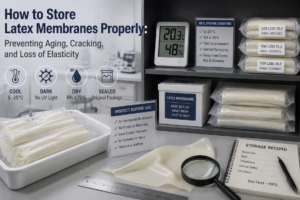
Regardless of material, membranes should be stored according to supplier instructions and inspected before use.
Natural Latex Sensitivity
Natural rubber products can contain proteins capable of causing allergic reactions in sensitized individuals.
A laboratory using natural latex should consider:
- supplier safety documentation;
- workplace risk assessment;
- employee sensitivity;
- handling procedures;
- suitable alternative materials where required.
A product described as low-protein or treated natural rubber should not be assumed to eliminate all risk unless supported by appropriate documentation.
This occupational-health issue is different from the membrane’s mechanical suitability for the test. Both should be considered.
Is Natural Latex More Sustainable?
Natural rubber originates from a renewable agricultural resource, but this fact alone does not establish the environmental impact of a finished membrane.
A realistic comparison may need to consider:
- agricultural practices;
- compound additives;
- vulcanization;
- energy used in manufacturing;
- product rejection rate;
- test failure and replacement;
- transport;
- possible reuse;
- chemical contamination after testing;
- disposal route.
A vulcanized latex membrane should not automatically be described as rapidly biodegradable. Degradation depends on formulation and disposal conditions.
A durable synthetic membrane is also not necessarily environmentally preferable if its stiffness compromises data or if it cannot be used in the required geometry.
Environmental claims should be supported by product-specific evidence rather than inferred from whether the polymer is natural or synthetic.
How to Select a Membrane Material
Use the following sequence.
Step 1: Define the specimen
Record:
- specimen diameter;
- specimen height;
- particle size;
- particle angularity;
- surface condition;
- expected lateral strain.
Step 2: Define the test conditions
Identify:
- cell fluid;
- pore fluid;
- maximum pressure;
- back pressure;
- test temperature;
- expected duration;
- drainage condition;
- required strain range.
Step 3: Identify the accuracy requirement
Consider whether the specimen is:
- very soft;
- small in diameter;
- tested at low effective stress;
- sensitive to additional membrane restraint;
- used for precise volume-change measurement.
Step 4: Screen material compatibility
Eliminate materials with unacceptable:
- swelling;
- softening;
- cracking;
- property loss;
- permeability;
- temperature response.
Step 5: Compare mechanical behavior
Review:
- tensile stress at relevant extension;
- elastic recovery;
- tear resistance;
- puncture resistance;
- thickness and tolerance;
- dimensional consistency.
Step 6: Verify installation and sealing
Confirm that the membrane:
- can be installed without excessive stretch;
- fits the top cap and pedestal;
- provides sufficient sealing overlap;
- does not form severe wrinkles;
- remains intact during a representative pressure check.
Step 7: Document the choice
Record the material, manufacturer, batch where relevant, nominal dimensions, thickness and any special installation or correction procedure.
Practical Selection Matrix
| Test condition | Initial material consideration |
|---|---|
| Routine soil triaxial testing with compatible fluids | Natural rubber latex is often a practical starting point |
| High installation stretch | Compare extensibility, working modulus and recovery |
| Petroleum oil or fuel exposure | Evaluate an appropriate nitrile compound |
| Ozone or outdoor exposure | Evaluate EPDM, silicone or chloroprene compounds |
| Broad temperature range | Evaluate a suitable silicone or specialty elastomer |
| Angular or coarse specimen | Prioritize puncture risk, thickness and surface preparation |
| Very soft soil or low stress | Prioritize low membrane restraint |
| Long-duration test | Evaluate creep, relaxation, permeation and chemical aging |
| Natural-latex sensitivity | Evaluate occupational controls or a suitable synthetic alternative |
| Custom geometry | Compare manufacturability as well as material properties |
This matrix identifies candidates only. It does not replace product-specific verification.
Questions to Ask a Membrane Supplier
Before ordering a standard or custom membrane, ask for:
- base elastomer or material family;
- internal diameter and tolerance;
- length and tolerance;
- wall thickness and tolerance;
- recommended storage conditions;
- manufacturing date or shelf-life guidance;
- tensile test method;
- modulus at specified elongation;
- elongation at break;
- tear-test method;
- fluid-compatibility information;
- temperature limitations;
- available quality-control documentation;
- latex-protein information if relevant;
- custom size and thickness capability.
When comparing data sheets, confirm that values were measured using equivalent methods and conditions.
ASTM D412 notes that tensile properties depend on test conditions including temperature, extension rate, conditioning and specimen geometry. Numbers obtained by different methods should not be treated as directly interchangeable.
Frequently Asked Questions
Is latex better than silicone for triaxial testing?
Not universally. Natural latex may provide a thin, highly extensible membrane for routine soil tests. Silicone may be useful under particular temperature or ozone conditions but must be checked for tear resistance, permeability, stiffness and dimensions.
Is nitrile better than latex?
Nitrile may provide better resistance to many petroleum oils, but it can be less extensible or stiffer than natural latex. The specific compound and test fluid must be evaluated.
Is TPR stronger than latex?
TPR is not one specific polymer. Its properties depend on the particular thermoplastic elastomer family and grade. “Stronger” also does not establish that it has acceptable modulus, recovery or sealing performance.
Can EPDM be used as a triaxial membrane?
Potentially, if the finished membrane has suitable dimensions, flexibility, fluid compatibility and mechanical behavior. EPDM should generally be treated cautiously where petroleum oils are present.
Which membrane is best for angular gravel?
There is no universal answer. Particle size, angularity, surface preparation, membrane thickness, installation stretch and required restraint all matter. A thicker or protective system may reduce puncture risk but increase boundary effects.
Does a synthetic membrane always last longer?
No. Lifetime depends on the polymer, compound, fluid, temperature, ozone, strain, storage and test duration. A material that ages slowly in air may still be incompatible with the test fluid.
Is Shore hardness enough to compare membranes?
No. Hardness is an empirical indentation measurement and does not directly provide working tensile modulus, elongation, tear resistance or membrane force. ASTM D2240 specifically notes that no simple relationship exists between durometer hardness and a fundamental material property.
Can the membrane change the measured strength?
Yes. A stretching membrane can add restraint to the specimen. The effect is influenced by material, thickness, specimen diameter and strain.
Can chemical-resistance charts replace testing?
They are useful for screening but may not represent the exact compound, temperature, exposure time and stretched condition. Representative testing is preferable when compatibility is critical.
Should latex membranes be reused?
Reuse depends on the test procedure and quality requirements. A used membrane may contain pinholes, permanent set or localized thinning even if it looks intact. Inspect it carefully and follow the laboratory’s documented procedure.
Conclusion
Natural rubber latex remains a practical membrane material for many conventional triaxial tests because it can provide high extensibility and close conformity at relatively small thickness.
Its limitations include sensitivity to ozone, aging, some oils and chemicals, sharp particles and natural-latex exposure concerns.
Silicone, nitrile, chloroprene, EPDM, SBR and thermoplastic elastomers each offer different potential advantages, but none is a universal replacement. A synthetic material with better chemical or temperature resistance may also be thicker, stiffer, harder to install or more influential on specimen response.
The best membrane is the one that satisfies the actual test requirements:
- compatible with the fluids and temperature;
- sufficiently extensible for installation and deformation;
- resistant to expected puncture and tearing;
- dimensionally suitable for reliable sealing;
- thin and flexible enough to limit unwanted restraint;
- stable for the required test duration.
Material selection should be based on product-specific properties and representative conditions—not on broad claims that one elastomer is always stronger, cheaper, more durable or more accurate than another.
Technical References
- ASTM D412: Standard Test Methods for Vulcanized Rubber and Thermoplastic Elastomers—Tension
- ASTM D471: Standard Test Method for Rubber Property—Effect of Liquids
- ASTM D624: Standard Test Method for Tear Strength of Conventional Vulcanized Rubber and Thermoplastic Elastomers
- ASTM D1149: Standard Test Methods for Rubber Deterioration—Cracking in an Ozone Controlled Environment
- ASTM D2240: Standard Test Method for Rubber Property—Durometer Hardness