
A triaxial test determines how a cylindrical soil specimen responds when it is subjected to controlled confinement and axial loading. Its basic principle is to reproduce a simplified three-dimensional stress condition so that soil strength, deformation and pore-pressure behavior can be measured under defined drainage conditions.
In a conventional triaxial compression test, fluid pressure inside a sealed cell applies equal radial stresses to the specimen. A loading ram then increases the axial stress until a specified strain or failure condition is reached.
This arrangement allows engineers to control stresses, drainage and consolidation more carefully than in many simpler soil-strength tests.
The Principle in One Sentence
The basic principle of a triaxial test is to confine a cylindrical soil specimen with cell pressure, apply additional axial load and measure its stress–strain response under controlled drainage conditions.
How Stress Is Applied to the Specimen
A conventional triaxial test uses an axisymmetric stress condition.
The cell fluid applies the minor principal stress, ( \sigma_3 ), around the specimen. Because the radial stresses are equal:
[
\sigma_2 = \sigma_3
]
The loading ram applies the major principal stress, ( \sigma_1 ), along the specimen’s vertical axis.
The difference between the axial and confining stresses is commonly expressed as deviator stress:
[
q = \sigma_1 – \sigma_3
]
During compression, ( \sigma_1 ) increases while ( \sigma_3 ) is normally maintained at a selected value. The resulting axial deformation and load are measured continuously.
It is therefore more accurate to describe a conventional test as applying one axial principal stress and two equal radial principal stresses—not simply as applying pressure independently in three different directions.
Why Confining Pressure Is Used
Soil in the ground is restrained by the material surrounding it. A laboratory specimen tested without confinement cannot fully represent this condition.
The triaxial cell applies pressure around the specimen to create a controlled confining stress. Tests can then be repeated at several confinement levels to investigate how soil behavior changes with effective stress.
Confining pressure is a laboratory boundary condition. It should not automatically be treated as a direct equivalent of soil depth unless the in-situ stress conditions and test program justify that interpretation.
Total Stress and Effective Stress
For saturated soil, behavior is governed largely by effective stress rather than total stress alone.
The relationship is:
[
\sigma’ = \sigma – u
]
where:
- ( \sigma’ ) is effective stress;
- ( \sigma ) is total stress;
- ( u ) is pore-water pressure.
If pore pressure rises during undrained loading, effective confinement can decrease even when the total cell pressure remains constant. For this reason, pore-pressure measurement is especially important in consolidated-undrained testing.
Effective principal stresses may be written as:
[
\sigma’_1 = \sigma_1 – u
]
[
\sigma’_3 = \sigma_3 – u
]
Reliable effective-stress interpretation requires appropriate specimen saturation and accurate pore-pressure measurement.
Why Drainage Conditions Matter
The same soil can produce different results depending on whether drainage and consolidation are permitted.
Unconsolidated Undrained Test
In a UU test, the specimen is not allowed to consolidate under the selected cell pressure, and drainage is prevented during shearing.
The test is generally used to evaluate short-term undrained behavior. Results are commonly interpreted in terms of total stress.
Consolidated Undrained Test
In a CU test, the specimen is allowed to consolidate before shearing. Drainage is then closed during axial loading.
When pore pressure is measured, the test can provide both total-stress and effective-stress information.
Consolidated Drained Test
In a CD test, drainage is allowed during consolidation and shearing. The axial strain rate must be slow enough to avoid significant excess pore-pressure development.
This test is used to study drained strength and volume-change behavior.
For a detailed comparison, see UU, CU and CD triaxial tests.
What Happens During a Conventional Triaxial Test?
The underlying sequence can be summarized in four stages.
1. Specimen Preparation
A cylindrical specimen is prepared to the required dimensions and condition. Its diameter, height and initial mass are recorded.
The preparation method should match the purpose of the test. Undisturbed cohesive soil, remolded soil and reconstituted granular material require different procedures.
2. Membrane Installation and Confinement
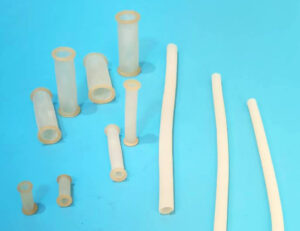
The specimen is placed between end platens and enclosed in a flexible latex membrane. O-rings seal the membrane at the specimen ends.
The cell is assembled and filled with fluid. Cell pressure is then applied, creating the radial confining stress.
The membrane must isolate the specimen from the cell fluid while transferring pressure with minimal interference.
3. Consolidation or Conditioning
Depending on the selected test type, the specimen may be saturated and consolidated before shearing.
This stage is essential in CU and CD testing because incomplete saturation or consolidation can lead to misleading results.
4. Axial Loading
The loading ram compresses the specimen at a controlled rate. The system records quantities such as:
- axial load;
- axial displacement;
- cell pressure;
- pore-water pressure;
- volume change, when applicable.
Testing continues until the specified failure criterion, strain limit or other termination condition is reached.
What Does the Test Measure?
The directly measured quantities depend on the apparatus and test method but may include load, displacement, pore pressure and drainage volume.
These measurements are used to calculate:
- axial strain;
- corrected specimen area;
- deviator stress;
- total and effective principal stresses;
- stress–strain response;
- pore-pressure response;
- volume change;
- shear-strength parameters.
The test does not directly “measure cohesion and friction angle” in one reading. These parameters are normally derived from a series of specimens tested under different confinement levels.
What Is Considered Failure?
Failure does not always mean that the specimen suddenly breaks.
Depending on the soil and test method, failure may be defined by:
- peak deviator stress;
- a specified axial strain;
- a stress-ratio criterion;
- critical-state or large-strain behavior.
Dense or overconsolidated soils may show a clear peak followed by strain softening. Normally consolidated clay or loose soil may continue to harden without a sharp peak.
The selected failure criterion should therefore be stated in the test report.
Why the Latex Membrane Matters
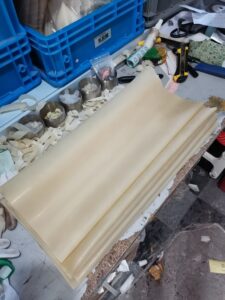
The latex membrane forms the flexible barrier between the specimen and the pressurized cell fluid.
It must be:
- watertight;
- flexible enough to follow specimen deformation;
- correctly sized for the specimen;
- resistant to puncture during installation and testing;
- reasonably uniform in thickness.
A membrane that is too thick can add restraint to the specimen. A membrane that is too thin may puncture, particularly when testing angular or coarse material.
For granular specimens, membrane penetration into surface voids can also affect the calculated volume and stress response. Corrections may be required when this effect is significant.
Learn more in:
- How to choose the right latex membrane thickness and size
- Membrane penetration effect in triaxial testing
- How triaxial latex membranes work
Common Misunderstandings
“Triaxial” Means Three Independently Controlled Loads
Not in a conventional axisymmetric triaxial compression test. The two radial principal stresses are equal, while the axial stress is increased separately.
True-triaxial equipment is required to control all three principal stresses independently.
Cell Pressure Is Always Equal to In-Situ Confinement
Cell pressure is selected according to the test program. Relating it to field conditions requires an appropriate stress-path and geotechnical model.
One Specimen Provides Complete Strength Parameters
A single test provides behavior at one selected confinement condition. Several specimens are normally required to establish a failure envelope or compare strength across stress levels.
Higher Deviator Stress Always Means a Better Test Result
Measured strength can be affected by saturation, strain rate, drainage, end restraint, sample disturbance, membrane behavior and calculation methods. Test quality must be evaluated before comparing peak values.
Basic Principle Versus Complete Test Procedure
Understanding the stress principle is only the starting point. A complete triaxial investigation also requires decisions about:
- specimen preparation;
- saturation criteria;
- consolidation;
- drainage conditions;
- strain rate;
- stress and strain corrections;
- failure definition;
- reporting requirements.
For the complete guide, including equipment, procedures, UU/CU/CD selection, calculations and common errors, see Triaxial Testing of Soil: Principles, Equipment, Procedures and Results.
Frequently Asked Questions
What is the main purpose of a triaxial test?
Its purpose is to measure soil strength and deformation under controlled axial stress, confinement and drainage conditions.
Why is it called a triaxial test?
The specimen is subjected to three principal stresses. In conventional triaxial compression, the two radial stresses are equal and the axial stress is controlled separately.
What is deviator stress?
In conventional triaxial compression, deviator stress is the difference between the major and minor principal stresses:
[
q = \sigma_1 – \sigma_3
]
What is the difference between total and effective stress?
Total stress includes the stress carried by both the soil skeleton and pore water. Effective stress is the portion associated with the soil skeleton and is commonly calculated as total stress minus pore-water pressure.
Does every triaxial test measure pore pressure?
No. Pore-pressure measurement depends on the test type, equipment and intended interpretation. It is particularly important when effective-stress parameters are required from a CU test.
Does a triaxial test always require a latex membrane?
Conventional soil triaxial testing normally uses a flexible membrane to isolate the specimen from the cell fluid. Its dimensions and properties must be appropriate for the specimen and testing conditions.
Conclusion
The basic principle of a conventional triaxial test is to subject a cylindrical soil specimen to equal radial confinement and controlled axial loading. By selecting the consolidation and drainage conditions and measuring stress, strain, pore pressure and volume change as required, engineers can investigate soil behavior under defined laboratory conditions.
The reliability of the result depends not only on the loading system but also on specimen quality, saturation, drainage control, measurement accuracy and correct latex membrane selection.


One Response