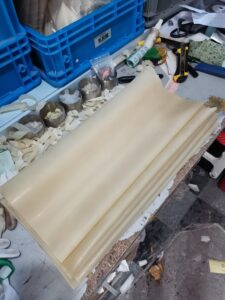

A triaxial test is performed to determine how soil responds to controlled confining pressure, axial loading and drainage conditions.
Its main purpose is to provide reliable information about soil strength, deformation, pore-water pressure and volume-change behavior. Engineers use these results when analyzing foundations, slopes, embankments, excavations, tunnels, earth-retaining structures and other geotechnical works.
Unlike a simple unconfined compression test, a triaxial test allows the laboratory to control the pressure surrounding the specimen. Different drainage and consolidation conditions can also be selected to represent short-term or long-term soil behavior.
However, a triaxial test does not provide every engineering parameter automatically. The information obtained depends on:
- the selected test type;
- specimen quality and preparation;
- saturation and consolidation procedures;
- drainage conditions;
- confining pressure;
- strain rate;
- pore-pressure measurement;
- calculation and failure criteria.
The Main Purpose of a Triaxial Test
The primary purpose of a triaxial test is to measure soil behavior under a defined stress condition that is more representative of confined soil than an unconfined laboratory test.
During a conventional triaxial compression test, a cylindrical specimen is enclosed in a flexible membrane and placed inside a pressure cell. Cell fluid applies radial confining pressure, while a loading ram applies additional axial stress.
This controlled arrangement enables engineers to investigate several important aspects of soil behavior.
1. Determine Soil Shear Strength
One of the most common purposes of triaxial testing is to determine the stress condition at which a soil specimen reaches a selected failure criterion.
In conventional triaxial compression:
- ( \sigma_1 ) is the major principal stress;
- ( \sigma_3 ) is the minor principal stress;
- the two radial principal stresses are equal;
- axial loading increases ( \sigma_1 ) while cell pressure controls ( \sigma_3 ).
The deviator stress is commonly expressed as:
$$
q = \sigma_1 – \sigma_3
$$
Testing comparable specimens at several confining pressures allows a relationship between strength and effective stress to be developed.
Depending on the test method and interpretation, the results may be used to determine:
- undrained shear strength;
- total-stress strength parameters;
- effective cohesion intercept;
- effective friction angle;
- stress ratio at failure;
- critical-state or large-strain strength.
A single specimen tested at one confining pressure does not normally provide a complete strength envelope. Several comparable specimens are usually needed when deriving parameters such as (c’) and (\phi’).
2. Measure Stress–Strain Behavior
A triaxial test is not only a failure test. It also records how the specimen deforms as stress increases.
The stress–strain curve can show:
- initial stiffness;
- nonlinear deformation;
- strain hardening;
- peak strength;
- strain softening;
- ductile behavior;
- brittle behavior;
- large-strain or critical-state response.
These characteristics may be important even when the specimen does not develop a sharp peak stress.
For example, dense granular soil or heavily overconsolidated clay may show a pronounced peak followed by strain softening. Loose sand or normally consolidated clay may continue to harden without a clearly defined peak.
The failure criterion must therefore be selected and reported rather than assumed from the appearance of the specimen alone.
3. Evaluate Pore-Water Pressure Response
Pore-water pressure strongly affects the behavior of saturated soil.
Effective stress can be expressed as:
$$
\sigma’ = \sigma – u
$$
where:
- ( \sigma’ ) is effective stress;
- ( \sigma ) is total stress;
- ( u ) is pore-water pressure.
During undrained shearing, pore water cannot freely leave the specimen. Changes in pore pressure therefore influence the effective stress carried by the soil skeleton.
A consolidated-undrained test with pore-pressure measurement can show whether the specimen develops positive or negative excess pore pressure during loading. This information allows the stress path to be interpreted in both total-stress and effective-stress terms.
Pore-pressure measurement is especially valuable when effective-stress strength parameters are required from a CU test. A CU test without reliable pore-pressure measurement cannot provide the same effective-stress interpretation.
4. Study the Effect of Drainage
Soil behavior can change substantially depending on whether pore water is allowed to drain.
A triaxial system allows engineers to select drainage and consolidation conditions according to the engineering problem.
Unconsolidated Undrained Test
In a UU test, the specimen is not permitted to consolidate under the selected cell pressure, and drainage remains closed during shearing.
Its main purpose is to provide a relatively rapid assessment of short-term undrained behavior, particularly for saturated, low-permeability cohesive soils.
UU results are normally interpreted using total stress.
Consolidated Undrained Test
In a CU test, the specimen is allowed to consolidate under the selected effective stress before drainage is closed for shearing.
Its purpose is to study the undrained response of soil after consolidation. When pore-water pressure is measured, both total-stress and effective-stress behavior can be evaluated.
CU testing is frequently selected because it can provide information about:
- undrained strength after consolidation;
- excess pore-pressure generation;
- total-stress behavior;
- effective-stress behavior;
- stress paths during undrained shearing.
Consolidated Drained Test
In a CD test, drainage is allowed during consolidation and shearing. Axial loading must be slow enough to prevent significant excess pore-pressure development within the specimen.
Its main purpose is to determine drained strength and volume-change behavior under effective-stress conditions.
CD testing is especially useful when long-term loading allows pore pressures to dissipate. Because adequate drainage must be maintained, CD tests can take considerable time for low-permeability soils.
For a more detailed comparison, see What Is the Difference Between CU and UU Triaxial Tests?.
What Does a Triaxial Test Measure Directly?
It is important to distinguish between quantities measured by the equipment and parameters subsequently calculated from those measurements.
Depending on the apparatus and selected test method, the directly measured quantities may include:
- axial load;
- axial displacement;
- cell pressure;
- back pressure;
- pore-water pressure;
- drainage volume;
- specimen volume change;
- elapsed time.
The accuracy of the final result depends on the accuracy, resolution and calibration of the instruments used to obtain these measurements.
Measurements may also be affected by system compliance, seating, drainage-line volume, piston friction, temperature change and other equipment-related factors.
What Parameters Can Be Calculated?
The measured data can be used to calculate or interpret parameters such as:
- axial strain;
- corrected specimen area;
- deviator stress;
- total principal stresses;
- effective principal stresses;
- mean effective stress;
- stress ratio;
- undrained shear strength;
- effective cohesion intercept;
- effective friction angle;
- secant or tangent stiffness;
- pore-pressure response;
- volumetric strain;
- dilation or contraction behavior.
Not every test provides every parameter.
For example:
- a UU test commonly provides total-stress undrained behavior;
- a CU test with pore-pressure measurement can provide both total- and effective-stress information;
- a properly conducted CD test provides drained strength and volume-change behavior.
The parameters reported should therefore match the test method, measurements and interpretation actually used.
Why Are Several Specimens Usually Tested?
One specimen represents soil behavior under one particular set of conditions.
To establish a failure envelope, comparable specimens are normally tested at different confining pressures. The resulting failure states can then be interpreted using an appropriate strength model.
A typical test series may include three or more specimens, but the necessary number depends on:
- the applicable standard;
- the purpose of the investigation;
- soil variability;
- specimen availability;
- the required parameter confidence;
- whether unusual or inconsistent behavior is observed.
The specimens should be sufficiently comparable for their results to be treated as one test series. Differences in density, water content, saturation, structure or disturbance can make the derived strength parameters unreliable.
How Are Triaxial Test Results Used in Engineering?
Triaxial results provide inputs for engineering analysis. They do not replace the complete process of site investigation, geological interpretation and design judgment.
Foundation Design
Strength and stiffness information may support evaluations of:
- bearing resistance;
- short-term undrained response;
- deformation under loading;
- excavation stability;
- soil–structure interaction.
Triaxial data may contribute to settlement analysis, but a conventional triaxial test does not automatically provide every parameter required for settlement prediction. Oedometer testing, field testing and other laboratory measurements may also be necessary.
Slope and Embankment Stability
UU or CU results may be used when analyzing short-term behavior in low-permeability soils. Effective-stress parameters from suitable CU or CD testing may be used for long-term stability analysis.
The selected parameters must be compatible with the drainage conditions assumed in the analysis.
Retaining Structures and Excavations
Triaxial testing can provide information about soil strength under loading or unloading conditions. This may support analyses involving:
- retaining walls;
- braced excavations;
- temporary works;
- basal heave;
- ground movement.
A conventional compression test may not reproduce every field stress path, so the testing program should reflect the intended analysis where stress-path dependence is important.
Dams and Earthworks
Triaxial tests may be used to investigate compacted fill, foundation soil and embankment materials.
The results can support assessments of:
- construction-stage stability;
- long-term stability;
- pore-pressure response;
- drained or undrained strength;
- deformation behavior.
Specimen preparation should reproduce the relevant density, moisture condition and compaction method as closely as practical.
Tunnels and Underground Construction
Strength, stiffness and stress-path behavior are important in underground construction.
Triaxial test data may help engineers evaluate how soil responds to stress changes around excavations. However, conventional triaxial compression does not independently control all three principal stresses and may not reproduce complex field stress paths without specialized procedures.
Seismic and Cyclic Loading
Static triaxial testing can provide useful background information about soil strength and stress response, but an ordinary static CU test does not by itself constitute a complete liquefaction assessment.
When cyclic or earthquake loading is the main concern, cyclic triaxial, cyclic simple-shear or other appropriate dynamic testing may be required.
Selecting a Test According to Its Purpose
| Test type | Consolidation before shearing | Drainage during shearing | Principal purpose | Common interpretation |
|---|---|---|---|---|
| UU | No | No | Rapid evaluation of short-term undrained response | Total stress |
| CU without pore-pressure measurement | Yes | No | Undrained strength after consolidation | Primarily total stress |
| CU with pore-pressure measurement | Yes | No | Undrained behavior and pore-pressure response after consolidation | Total and effective stress |
| CD | Yes | Yes | Drained strength and volume-change behavior | Effective stress |
The correct test should be selected according to the engineering condition being represented—not simply according to which procedure is fastest or most readily available.
What Can a Conventional Triaxial Test Not Determine Alone?
Although triaxial testing is versatile, its limitations must be understood.
A conventional triaxial test cannot, by itself:
- represent every possible field stress path;
- control all three principal stresses independently;
- eliminate the effects of specimen disturbance;
- establish reliable strength parameters from one specimen;
- replace a full site investigation;
- provide every parameter required for settlement analysis;
- reproduce cyclic earthquake loading through an ordinary static test;
- remove the need to select an appropriate constitutive or strength model.
The two radial principal stresses are equal in a conventional axisymmetric triaxial test:
$$
\sigma_2 = \sigma_3
$$
A true-triaxial apparatus is required when all three principal stresses must be controlled independently.
To understand the loading principle in more detail, read What Is the Basic Principle of a Triaxial Test?.
Why Specimen Quality Matters
Even accurate equipment cannot compensate for a poor-quality specimen.
Results can be influenced by:
- sampling disturbance;
- stress relief after sampling;
- cracks or fissures;
- moisture loss;
- nonuniform trimming;
- incorrect dimensions;
- density variation;
- incomplete saturation;
- insufficient consolidation;
- inappropriate strain rate.
For undisturbed samples, trimming and handling should minimize changes to the natural soil structure.
For remolded or reconstituted specimens, the preparation method, density and water content should be documented so the result can be reproduced and interpreted correctly.
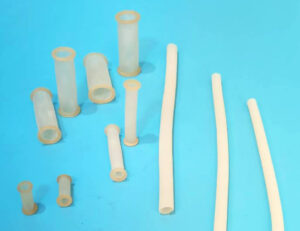
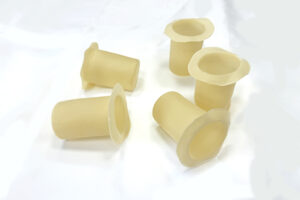
Why the Latex Membrane Matters
The latex membrane separates the soil specimen from the pressurized cell fluid while allowing confining pressure to act on the specimen.
Although it is a relatively small component, its condition and dimensions can affect test reliability.
The membrane should:
- fit the specimen diameter correctly;
- be sufficiently long to seal securely at both ends;
- have reasonably uniform thickness;
- remain flexible during deformation;
- resist puncture during installation and testing;
- be free from holes, cuts and visible deterioration.
A membrane that is unnecessarily thick may add restraint and require a membrane-force correction. A membrane that is too thin may be more vulnerable to puncture, particularly when testing angular or coarse-grained material.
Other potential problems include:
- wrinkles trapped against the specimen;
- excessive stretching during installation;
- damage caused by sharp particles;
- leakage at the O-ring seals;
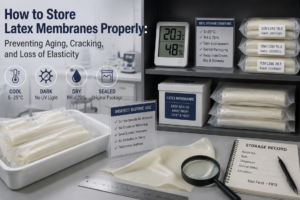
- deterioration caused by storage or chemical exposure;
- penetration into surface voids in granular specimens.
Membrane penetration can influence apparent specimen volume and stress calculations. Its significance depends on factors such as particle size, confining pressure, membrane thickness and specimen surface condition.
For practical guidance, see:
- How to Choose the Right Thickness and Size of Latex Membrane for Triaxial Tests
- Membrane Penetration Effect in Triaxial Testing Explained
- How Triaxial Latex Membranes Work
Factors That Affect the Reliability of the Results
Reliable triaxial data require more than simply loading the specimen to failure.
Important factors include:
Saturation
Incomplete saturation can affect pore-pressure response and effective-stress calculations. When saturation is required, it should be assessed using the procedure and acceptance criteria applicable to the selected test method.
Consolidation
In CU and CD testing, the specimen must be allowed to consolidate adequately under the selected stress condition before shearing begins.
Strain Rate
The selected axial strain rate must suit the drainage condition and soil permeability.
A CD test requires a sufficiently slow rate to prevent significant excess pore pressure. The requirements for an undrained test are different because drainage is intentionally prevented during shearing.
Area Correction
As the specimen shortens and expands, its cross-sectional area changes. Deviator stress calculations should use an appropriate area correction.
The simple constant-volume correction may not be suitable for every test condition, especially where measured volume change, localization or large deformation is significant.
End Restraint
Friction and restraint at the specimen ends can contribute to nonuniform deformation and influence the measured response.
Instrument Accuracy
Load, displacement, pressure and volume-change instruments should have suitable capacity, resolution and calibration for the expected measurements.
Frequently Asked Questions
What is the main purpose of a triaxial test?
Its main purpose is to measure soil strength and deformation under controlled confining pressure, axial loading and drainage conditions.
What properties can a triaxial test determine?
Depending on the selected method, it may provide undrained strength, effective-stress strength parameters, stress–strain response, pore-pressure response, stiffness and volume-change behavior.
Can one triaxial test determine cohesion and friction angle?
Normally, no. A failure envelope generally requires a series of comparable specimens tested under different confining pressures.
Which triaxial test is used for short-term stability?
A UU or CU test may be appropriate for short-term undrained problems, depending on the soil condition, stress history, required parameters and analysis method.
Which test is used for long-term stability?
Effective-stress parameters obtained from an appropriate CU test with pore-pressure measurement or from a CD test may be used for long-term analysis. The selected laboratory stress path and drainage conditions must be consistent with the engineering problem.
Can a triaxial test predict settlement?
Triaxial testing can provide stress–strain and stiffness information relevant to deformation analysis. However, it does not automatically replace consolidation tests, field tests or other information required for settlement assessment.
Why is pore pressure measured in a CU test?
Pore-pressure measurement allows total stresses to be converted to effective stresses during undrained shearing. This makes it possible to examine the effective stress path and derive effective-stress strength information from a suitable series of tests.
Is a triaxial test suitable for liquefaction assessment?
A conventional static triaxial test is not, by itself, a complete liquefaction test. Cyclic triaxial or other appropriate cyclic testing is generally required when repeated earthquake loading is being evaluated.
Does membrane thickness affect the test result?
Yes. Membrane stiffness can add radial restraint, while an excessively thin or damaged membrane can puncture or leak. Membrane penetration into granular specimens can also affect measurements and calculations.
Is failure always a visible shear plane?
No. Some specimens develop a distinct shear plane, while others bulge or continue deforming without a sudden break. Failure should be defined using the applicable test method and stated interpretation criterion.
Conclusion
The purpose of a triaxial test is to obtain controlled and interpretable information about soil strength, deformation, pore-pressure response and volume change.
By selecting suitable consolidation, drainage and loading conditions, engineers can generate parameters for short-term or long-term geotechnical analysis. The results may support the design of foundations, slopes, embankments, excavations, retaining structures, dams and underground works.
Reliable interpretation requires an appropriate test program, representative specimens, accurate measurements and clearly defined calculation and failure criteria. Latex membrane selection and installation also matter because the membrane must isolate the specimen without introducing leakage, puncture or excessive restraint.
For a complete explanation of the apparatus, test stages, calculations and common sources of error, read Triaxial Testing of Soil: Principles, Equipment, Procedures and Results.