
Triaxial testing is important because soil strength is not a single, fixed property. Soil behavior changes with confining stress, drainage conditions, pore-water pressure, density, stress history and loading path.
A triaxial test allows several of these factors to be controlled and measured under documented laboratory conditions. This makes it possible to obtain strength and deformation data that are more suitable for many geotechnical analyses than values based only on classification tests or simple strength tests.
The importance of triaxial testing does not mean it is required for every project. Its value is greatest when engineers need to understand how soil will behave under specific stress and drainage conditions, particularly when pore-pressure response, effective stress, deformation or changes in strength with confinement are important.
Short Answer
Triaxial testing is important because it allows engineers to:
- apply a controlled confining pressure;
- select consolidation and drainage conditions;
- measure axial stress and deformation;
- measure pore-water pressure when required;
- study strength at different stress levels;
- obtain total-stress or effective-stress parameters;
- observe strain hardening, peak strength and strain softening;
- evaluate contraction, dilation or volume change;
- generate parameters that are consistent with a particular engineering analysis.
This level of control helps reduce uncertainty when evaluating foundations, slopes, embankments, excavations, retaining structures and underground works.
Soil Strength Depends on Stress Conditions
Soil does not normally have one strength value that can be applied to every engineering problem.
Its measured strength may depend on:
- effective confining stress;
- density or void ratio;
- water content;
- degree of saturation;
- stress history;
- overconsolidation ratio;
- drainage conditions;
- rate of loading;
- soil structure;
- specimen disturbance;
- direction and path of loading.
This is one reason why a result from a simple index test should not automatically be treated as a complete design parameter.
In a conventional triaxial compression test, the specimen is subjected to an axisymmetric stress state. The cell pressure applies the radial principal stresses, while the loading system increases the axial principal stress.
The radial stresses are equal:
$$
\sigma_2 = \sigma_3
$$
The deviator stress is commonly expressed as:
$$
q = \sigma_1 – \sigma_3
$$
where:
- ( \sigma_1 ) is the major principal stress;
- ( \sigma_3 ) is the minor principal stress;
- ( q ) is the deviator stress.
Because the laboratory can select the confining pressure, comparable specimens can be tested at different stress levels. This provides a more useful picture of how soil strength changes with confinement.
For a focused explanation of the stress system, see What Is the Basic Principle of a Triaxial Test?.
Why Controlling Confining Pressure Matters
Soil in the ground is normally restrained by surrounding material. Its response under load therefore depends partly on the stresses acting around it.
An unconfined specimen does not reproduce this restraint. By contrast, the triaxial cell applies a controlled pressure around the specimen.
This allows the laboratory to investigate questions such as:
- Does the soil become stronger as effective confinement increases?
- Does the specimen show a clear peak strength?
- Does it harden continuously with strain?
- Does it become more or less brittle at different confinement levels?
- Does it contract or dilate during shearing?
- How does stiffness change with stress level?
Confining pressure should not be described as an exact simulation of soil depth without additional analysis. Field stresses depend on soil unit weight, groundwater, stress history, lateral stress conditions and construction sequence.
The selected cell pressure is a laboratory boundary condition. It should be chosen to support the intended interpretation and, where appropriate, represent a relevant range of field effective stresses.
Why Drainage Control Matters
Water movement has a major influence on saturated soil behavior.
If loading occurs faster than pore water can drain, excess pore-water pressure may develop. If sufficient time is available for drainage, that excess pressure may dissipate.
The same soil can therefore exhibit different strengths and deformation characteristics under short-term undrained and long-term drained conditions.
Triaxial equipment allows the drainage path to be opened or closed according to the selected test method.
Unconsolidated Undrained Conditions
In an unconsolidated-undrained test, drainage is not permitted during the application of cell pressure or during shearing.
This procedure is commonly used to investigate rapid undrained loading of saturated, low-permeability cohesive soil. Results are normally interpreted in terms of total stress.
Consolidated Undrained Conditions
In a consolidated-undrained test, the specimen is allowed to consolidate before the drainage valves are closed for shearing.
If pore-water pressure is measured during the undrained shearing stage, the test can provide information in both total-stress and effective-stress terms.
Consolidated Drained Conditions
In a consolidated-drained test, drainage is allowed during consolidation and shearing. The specimen must be loaded slowly enough to prevent significant excess pore-pressure development.
This procedure is used to evaluate drained strength and volume-change behavior.
Controlling drainage is important because the laboratory condition must be consistent with the engineering condition being analyzed. Using drained parameters in an undrained problem—or undrained parameters in a drained problem—can lead to an inappropriate assessment.
For additional guidance, see What Is the Difference Between CU and UU Triaxial Tests?.
Why Pore-Water Pressure Measurement Matters
For saturated soil, total stress alone does not completely describe the stress carried by the soil skeleton.
Effective stress is commonly expressed as:
$$
\sigma’ = \sigma – u
$$
where:
- ( \sigma’ ) is effective stress;
- ( \sigma ) is total stress;
- ( u ) is pore-water pressure.
During undrained shearing, pore pressure may increase or decrease even when the total cell pressure remains constant. This changes the effective stress within the specimen.
Pore-pressure measurement in a suitable CU test allows engineers to evaluate:
- excess pore-pressure generation;
- effective principal stresses;
- effective stress paths;
- stress ratio at failure;
- total-stress and effective-stress behavior;
- whether the soil response is contractive or dilative.
A CU test does not automatically provide reliable effective-stress parameters. The specimen must be appropriately saturated, the pressure-measurement system must perform correctly, and pore pressure must actually be measured during shearing.
This ability to measure pore-pressure response is one of the major reasons triaxial testing is valuable for saturated soils.
More Than Failure Strength
Triaxial testing is sometimes described only as a method for measuring soil shear strength. In practice, the complete stress–strain response may be just as important as the stress recorded at failure.
A triaxial test can show:
- initial and secant stiffness;
- nonlinear deformation;
- yield-related behavior;
- peak deviator stress;
- strain hardening;
- strain softening;
- brittle or ductile response;
- large-strain strength;
- volume contraction;
- dilation;
- pore-pressure development.
Not every soil develops a distinct peak stress.
Dense granular soil and heavily overconsolidated clay may show a peak followed by strain softening. Loose granular soil and normally consolidated clay may continue to harden without producing a sharp maximum.
For this reason, failure must be defined using the applicable procedure or a stated interpretation criterion. A visible shear plane should not be treated as the only possible definition of failure.
Triaxial Test Versus Simpler Soil Strength Tests
Triaxial testing generally requires more time, equipment and technical control than simple strength tests. Its importance becomes clearer when its capabilities are compared with those of other methods.
| Test | Controlled confining stress | Drainage control | Pore-pressure measurement | Predetermined failure plane |
|---|---|---|---|---|
| Conventional triaxial test | Yes | Yes | Available with suitable equipment | No |
| Direct shear test | Not controlled in the same way | Limited by the apparatus and procedure | Generally not measured | Yes |
| Unconfined compression test | No | Limited | Generally not measured | No |
| Laboratory vane shear test | No independently controlled cell pressure | No conventional drainage control | No | Failure mechanism influenced by vane rotation |
This comparison does not mean the triaxial test is always superior.
A direct shear test may be useful when the behavior along a defined interface or shear plane is of interest. An unconfined compression test can provide a rapid strength index for suitable cohesive specimens. Vane testing can be useful for evaluating soft cohesive soils under appropriate conditions.
The correct test depends on:
- the material being investigated;
- the engineering question;
- the analysis method;
- the required parameters;
- specimen availability;
- project risk;
- applicable standards and specifications.
Triaxial testing becomes especially valuable when simpler tests cannot provide adequate stress, drainage or pore-pressure control.
Why One Specimen Is Usually Not Enough
One triaxial specimen represents the soil response under one set of specimen and loading conditions.
If the objective is to establish how strength changes with effective stress, several comparable specimens are normally tested at different confining pressures.
A test series may be used to develop:
- a total-stress failure relationship;
- an effective-stress failure envelope;
- undrained strength at different consolidation stresses;
- stress-dependent stiffness;
- pore-pressure response at different confinement levels.
The specimens must be sufficiently comparable for the results to be interpreted as one series.
Important sources of variation include:
- initial water content;
- density or void ratio;
- degree of saturation;
- soil structure;
- specimen dimensions;
- sampling disturbance;
- trimming damage;
- consolidation history;
- inclusions, fissures or laminations.
More specimens do not automatically produce better parameters if their initial conditions are inconsistent.
When Is Triaxial Testing Worth the Additional Time?
Triaxial testing is particularly valuable when one or more of the following conditions apply.
Effective-Stress Parameters Are Required
A suitable CU test with pore-pressure measurement or a CD test may be needed when effective-stress strength parameters are required for the selected analysis.
Pore-Pressure Response Is Important
Triaxial testing can measure changes in pore-water pressure during undrained loading. This is important when the soil response cannot be interpreted reliably from total stress alone.
Drainage Conditions Affect the Design
If short-term and long-term behavior may differ significantly, the laboratory testing program should distinguish between undrained and drained conditions.
Strength Changes with Stress Level
Testing at several confining pressures can show whether the soil response changes across the stress range relevant to the project.
Stress–Strain or Stiffness Information Is Needed
When deformation matters, a single failure-strength value may be insufficient. Triaxial testing provides a continuous stress–strain record, subject to the limitations of the measurement system.
Volume Change Is Important
Suitable drained testing can indicate whether the specimen contracts or dilates during shearing.
The Project Has Significant Geotechnical Risk
Higher-risk foundations, slopes, embankments, excavations and underground works may justify a more detailed laboratory investigation.
A Numerical Model Requires Suitable Input Parameters
Advanced analysis does not improve reliability when the input parameters are poorly matched to the material and stress conditions. Triaxial testing may provide some of the data needed for parameter calibration, although additional testing is often required.
When Might a Simpler Test Be Sufficient?
A complex triaxial program may not be necessary for every investigation.
Simpler testing may be appropriate when:
- only a preliminary strength index is required;
- the project has low geotechnical risk;
- the soil and engineering conditions are well understood;
- reliable local correlations already exist;
- specimen quality is insufficient for detailed interpretation;
- the design method specifically uses parameters from another test;
- the behavior of an interface or predetermined shear plane is the main concern.
The decision should be based on the quality of information needed—not merely on the relative cost or speed of the test.
Important Limitations of Triaxial Testing
Triaxial testing provides controlled data, but it is not a perfect reproduction of the ground.
Axisymmetric Stress State
In a conventional triaxial test, the two radial principal stresses are equal. The apparatus does not independently control all three principal stresses.
A true-triaxial apparatus is required when independent control of all three principal stresses is necessary.
Specimen Disturbance
Sampling, transportation, extrusion and trimming can change soil structure and stress state. A precise laboratory test on a badly disturbed specimen may not represent in-situ behavior.
End Restraint
Friction and restraint at the specimen ends can contribute to nonuniform stress and deformation.
Limited Specimen Size
A small specimen may not represent soil containing large particles, fissures, laminations or spatial variability.
Laboratory Stress Path
The stress path used in a conventional compression test may not reproduce the stress history of an excavation, tunnel or another complex field problem.
Rate Effects
An unsuitable loading rate can affect the measured response. In a drained test, loading too quickly may prevent adequate drainage. Soil may also show time-dependent behavior independent of drainage.
Interpretation Dependence
Calculated parameters depend on area corrections, failure definitions, stress variables and the selected strength or constitutive model.
These limitations do not make the test unimportant. They show why the test method, specimen condition and interpretation assumptions must be reported clearly.
Why Membrane Quality Affects Test Reliability
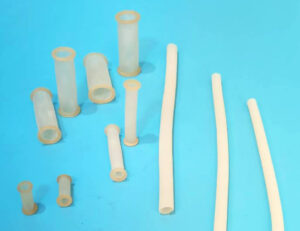
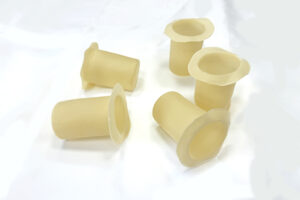
A triaxial specimen is normally enclosed in a flexible latex membrane. The membrane separates the specimen from the pressurized cell fluid while allowing confinement to be transmitted to the specimen.
Membrane performance matters because a damaged or unsuitable membrane can affect both the test procedure and the calculated result.
Potential problems include:
- leakage through a puncture or tear;
- cell fluid entering the specimen;
- excessive membrane restraint;
- wrinkles trapped against the specimen;
- poor sealing around the end platens;
- excessive stretching during installation;
- deterioration during storage;
- membrane penetration into surface voids.
A membrane that is too thick may add radial restraint and contribute to the measured deviator load. Depending on the test conditions and applicable procedure, a membrane correction may be necessary.
A membrane that is too thin may be vulnerable to puncture, particularly when the specimen contains coarse or angular particles.
Membrane penetration occurs when the flexible membrane moves into voids at the surface of a granular specimen. The effect can influence volume-change measurements and the calculated specimen response.
Its significance depends on factors such as:
- particle size;
- particle angularity;
- membrane thickness;
- confining pressure;
- specimen diameter;
- surface preparation;
- applied strain.
Correct membrane selection should therefore consider more than specimen diameter alone. Thickness, length, elasticity, pressure conditions and puncture risk must also be evaluated.
Related guidance:
- How to Choose the Right Thickness and Size of Latex Membrane for Triaxial Tests
- Membrane Penetration Effect in Triaxial Testing Explained
- How Triaxial Latex Membranes Work
What Makes Triaxial Data Reliable?
The presence of sophisticated equipment does not guarantee a reliable result.
Test quality also depends on:
- representative sampling;
- careful specimen preparation;
- accurate specimen dimensions;
- appropriate saturation;
- complete consolidation when required;
- correct drainage control;
- suitable strain rate;
- calibrated instruments;
- leak-free pressure systems;
- correct area and stress calculations;
- documented failure criteria;
- appropriate membrane selection;
- consistent interpretation.
The test report should clearly identify the procedure, initial specimen condition, stress history, pressure stages, drainage conditions and interpretation method.
Without this information, even a plausible strength value may be difficult to use correctly.
How Triaxial Data Supports Engineering Decisions
Triaxial testing does not independently design a foundation or determine whether a structure is safe. It provides laboratory evidence that can support engineering analysis.
Depending on the test program, the results may contribute to:
- foundation bearing-resistance analysis;
- short-term stability of cohesive soil;
- long-term slope and embankment stability;
- excavation and retaining-structure analysis;
- earth-dam design;
- evaluation of compacted fill;
- tunnel and underground construction analysis;
- deformation modeling;
- comparison of soil-treatment methods;
- calibration of soil models.
The parameters selected for design must correspond to the expected field drainage condition, stress range and loading path.
Triaxial results should also be evaluated alongside:
- borehole and sampling records;
- geological conditions;
- groundwater information;
- field test results;
- other laboratory tests;
- construction sequence;
- engineering judgment.
To review the parameters and applications in more detail, read What Is the Purpose of a Triaxial Test?.
For a complete guide to equipment, test stages and interpretation, see Triaxial Testing of Soil: Principles, Equipment, Procedures and Results.
Frequently Asked Questions
Why is the triaxial test considered reliable?
It provides controlled confining pressure, drainage conditions and axial loading. Suitable systems can also measure pore-water pressure and volume change. Reliability still depends on specimen quality, equipment performance and correct interpretation.
Is a triaxial test more accurate than a direct shear test?
The tests provide different types of information. A triaxial test offers greater control over confinement, drainage and pore pressure, while a direct shear test may be appropriate for interfaces or behavior along a defined shear plane. The better method depends on the engineering objective.
Why is confining pressure important?
Soil strength and deformation generally depend on stress level. Controlled confinement allows specimens to be tested under several defined stress conditions.
Why is pore pressure important in a triaxial test?
Pore pressure affects the effective stress carried by the soil skeleton. Measuring it during a suitable undrained test allows the effective stress path to be evaluated.
Can one specimen provide the friction angle and cohesion?
Normally, a series of comparable specimens tested at different confining pressures is required to establish a failure relationship. One specimen provides only one stress–strain response under one selected set of conditions.
Does triaxial testing reproduce exact field conditions?
Not exactly. It creates a controlled laboratory stress state that can represent selected aspects of field behavior. Conventional triaxial compression remains axisymmetric and may not reproduce every stress path or soil feature.
Is triaxial testing always necessary?
No. Simpler tests may be sufficient for preliminary, low-risk or narrowly defined purposes. Triaxial testing becomes more valuable when stress level, drainage, pore pressure, stiffness or detailed strength behavior matters.
Why is the latex membrane important?
The membrane isolates the specimen from the cell fluid and transfers confining pressure. Incorrect thickness, poor sizing, punctures, wrinkles or penetration into surface voids can influence test performance and measured results.
Can an ordinary triaxial test evaluate liquefaction?
An ordinary static triaxial compression test is not a complete liquefaction assessment. Appropriate cyclic testing and a broader geotechnical evaluation are generally required when earthquake-induced liquefaction is being investigated.
Conclusion
Triaxial testing is important because it allows soil behavior to be studied under controlled stress, drainage and pore-pressure conditions.
Its main advantage is not simply that it produces a shear-strength value. A properly planned test series can show how strength, stiffness, deformation, pore pressure and volume change vary with confinement and loading conditions.
This information can reduce uncertainty and improve the selection of parameters for geotechnical analysis. However, the value of the results depends on representative specimens, suitable test conditions, accurate measurements and technically appropriate interpretation.
Triaxial testing should therefore be viewed as one part of a complete geotechnical investigation—not as a substitute for site characterization, field testing or engineering judgment.